
Nexion Tiles in Noida: Collections, Sizes and a Price Guide from the Showroom
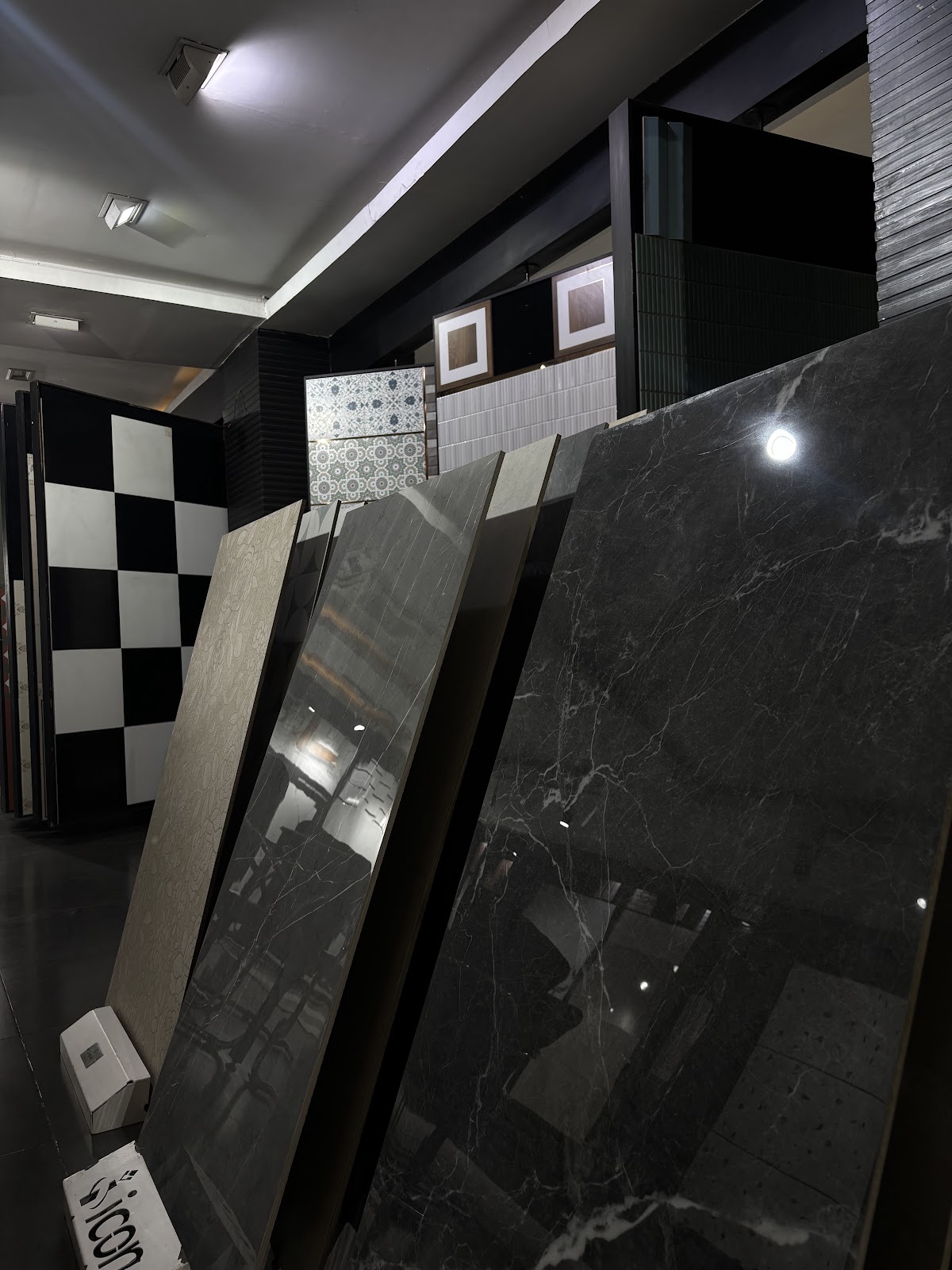
On a weekday afternoon in Sector 9 the most common thing we hear is a customer standing in front of a 1200x2400 slab and saying "this is not a tile". They are half right. Nexion is porcelain, it is made in Morbi, and it is fixed with adhesive like any other tile. But the density, the size, the depth of the print and the way two slabs can be mirrored at a joint put it in a different category from the 600x600 vitrified most Noida flats are built with. This guide is what we tell people across the counter about the brand: where it comes from, the four surface families we hold, the sizes and thicknesses, what it costs as a moving range, and how to decide if it is right for your job.
What Nexion is, and who makes it
Nexion is an Indian premium porcelain slab brand set up in 2015 as a joint venture between Ceramiche Speranza, an Italian ceramics house that has been making tiles since 1961, and an established Morbi manufacturing group. The company is headquartered in Ahmedabad and produces at a dedicated plant in Morbi, Gujarat, which is why the product carries Italian design direction and Italian finishing technology at an Indian factory price. The brand's own site at nexiontiles.com describes the material as sintered, pressed at over 40,000 tonnes of force and fired above 1200 degrees, and that pair of numbers is the short answer to why the slabs behave differently from a standard vitrified tile.
We stock and display Nexion at both our locations, the Sector 9 Noida showroom and the Shree Balaji Ceramics warehouse in Bawana, Delhi. Our Nexion page lists the current surfaces on the floor, but the brand's catalogue changes often enough that the showroom rack is the better reference. What does not change is the split into four material families, and that is how we organise the display.
How Nexion differs from standard Morbi vitrified
Morbi makes excellent vitrified tile at a price nobody else in the world can match, and we sell a great deal of it. The difference with Nexion is not that Morbi is bad; it is that the two products are engineered for different results. Four things separate them.
The first is body density. A slab that is 6 mm thick and 2.4 metres long has to survive pressing, firing, packing, a truck to Noida, a stair carry and a suction lifter without cracking. That demands a fully vitrified body with water absorption well under the 0.5 percent that the Indian standard IS 13006 sets for porcelain, and a much higher pressing force than a 600x600 tile line uses. The Bureau of Indian Standards classification is the same for both products on paper; in the hand, a Nexion slab rings when tapped where a budget vitrified tile thuds.
The second is size. Standard Morbi vitrified tops out at 800x1600 for most factories, and many still run 600x600 and 600x1200 as their bread and butter. Nexion's grid goes up to 1200x2400, which is the size that makes a wall or floor read as stone rather than as a grid of printed pictures. Our post on large format tiles and their honest drawbacks goes through what that size demands of the room.
The third is print depth. All modern marble finish tiles are digitally printed, but the number of print heads, the ink chemistry and the number of unique faces in a series vary enormously. Nexion prints across the full slab from high resolution scans of real marble and stone, with dozens of unique faces per series, so a 300 sq ft floor does not show the same vein twice. On a Rs 50 per sq ft GVT you will typically see the same four or six faces repeat, and once you have noticed the repeat you cannot stop seeing it.
The fourth is book match. Because the print is continuous across the slab, Nexion produces mirrored pairs where slab A and slab B meet at a joint and the vein folds back on itself like an open book. This is how the great marble bathrooms and hotel lobbies are done in real stone, and it is only possible with a slab product. Standard vitrified cannot do it.
The four families we hold
Nexion names its series after Italian quarries, rivers and stones, and the names change with each catalogue. We do not organise the showroom by series name because customers do not think that way. They think in materials, and the brand's output fits neatly into four.
Marble finish
The largest family and the reason most people ask for the brand. White and ivory grounds with grey or gold veining in the Calacatta and Statuario manner, warm cream stones, and dark dramatic marbles in black, green and bordeaux. The finishes here are the full lappato mirror polish, a softer lappato matt, satinato and naturale. Browse the wider marble finish collection to see how these sit beside other brands, and read our comparison of marble look porcelain against Italian marble in Delhi NCR if that is the decision you are weighing.
Stone: travertine and limestone
Banded travertine in ivory, walnut and silver, and the quieter limestones with their fossil flecks and soft cloud. These are almost always sold in naturale, soft naturale or a structured grainy finish, and they are the family we recommend most often for large living floors because the low contrast hides dust between mops. The stone look collection shows the range.
Concrete
Cast concrete, plaster and resin looks in greys, taupes and near blacks, usually in absolute matte or naturale. Concrete slabs are what most of the commercial lobbies and offices we supply in Delhi NCR are choosing this year, and at home they work under a wood finish wall or a warm kitchen. See the concrete look collection.
Wood finish
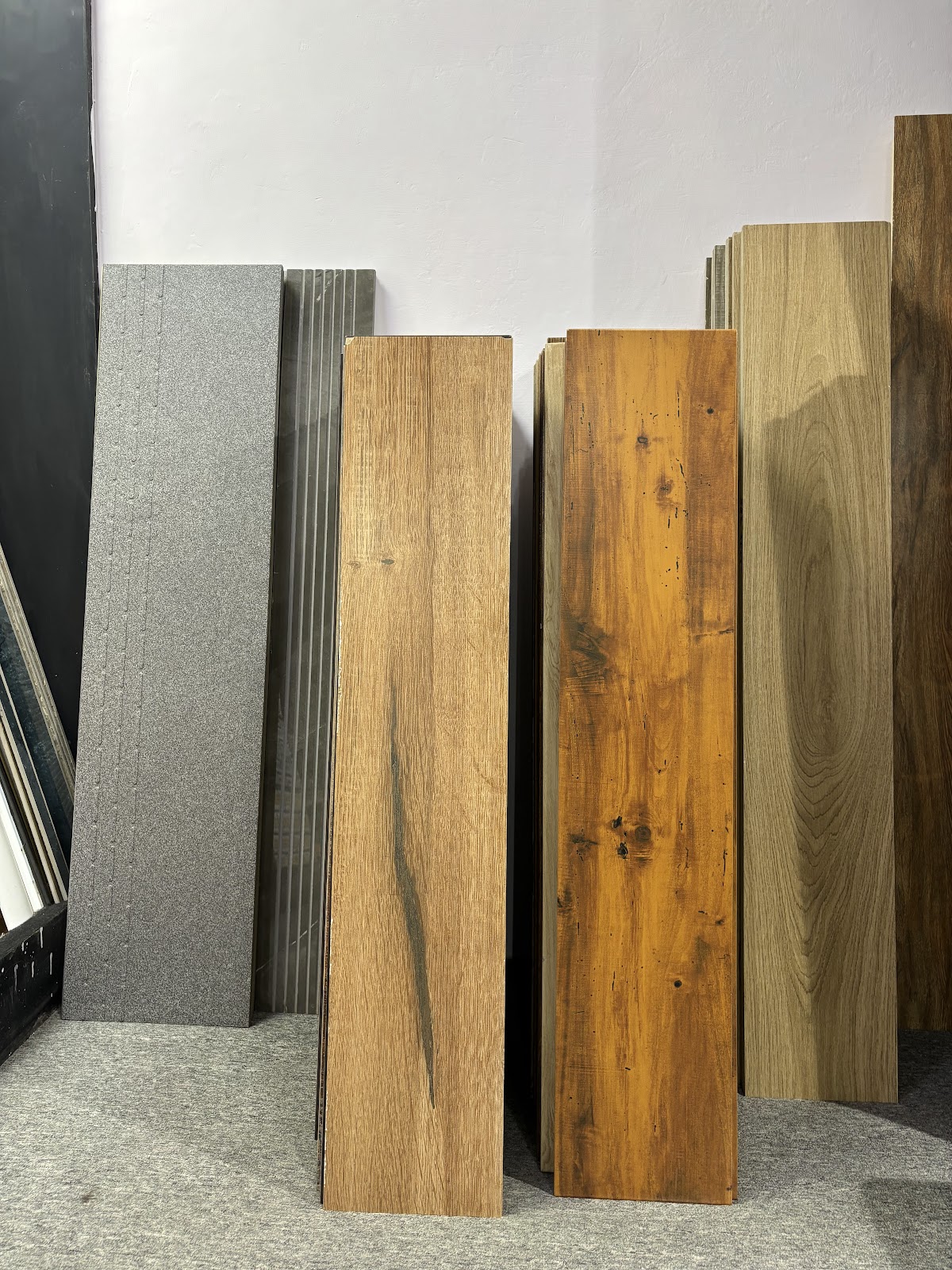
Oak, walnut and weathered plank looks, mostly in the 200x1200 plank format with a spazzolato brushed texture that carries the grain into the surface. This is the one family where the 1200x2400 slab is rarely the right size; planks are the point. The wood look collection has the current options.
Sizes and thicknesses, and what each is for
The table below is the grid Nexion produces, with the thicknesses we see in Noida. A few sizes in the wider slab market, such as 1600x3200 and 12 or 20 mm bodies, are made by other plants and can be sourced on request, but they are not standard Nexion items and we have marked them as such.
| Size (mm) | Thickness | Format | Typical use |
|---|---|---|---|
| 300x600 and 600x600 | 9 mm | Standard tile | Bathroom walls, utility areas, matching corridors to a slab floor |
| 200x1200 | 9 mm | Plank | Wood finish floors and feature walls |
| 600x1200 | 9 mm | Large format | Bedrooms, bathroom floors, budget conscious living rooms |
| 800x1600 | 9 mm | Large format | Living and dining rooms of 150 to 300 sq ft, kitchen walls |
| 1200x1200 | 9 mm | Square slab | Square rooms, offices, showrooms |
| 1200x1800 | 6 and 9 mm | Slab | Feature walls, wide corridors |
| 1200x2400 | 6 mm (walls), 9 mm (floors and counters) | Slab | Open plan living, book matched walls, kitchen counters, lobbies, facades |
| 1600x3200 and 12 to 20 mm bodies | Varies | Special order, wider market | Terraces, exterior paving, oversize counters; not standard Nexion |
Thickness is the detail that trips people up. The 6 mm slab is a wall product: it is light enough for two people to carry, it is what goes on ventilated facades, and it saves a real amount of money on a bathroom. It is not for a floor that will take a piano or a marble dining table. For floors and counters ask for 9 mm, and do not let a contractor talk you into 6 mm on the ground to save weight in a lift.
Nexion price guide for Noida
These are showroom ranges that move with the season, with the catalogue and with the Morbi plant's own pricing, so please read them as a guide and ask us for a live quote. All figures are for material only, per sq ft, before GST at 18 percent. Finish matters as much as size: a full lappato marble at 1200x2400 sits at the top of its band, while a naturale stone in the same size sits near the bottom.
| Size and finish | Showroom range (Rs per sq ft, material) | Adhesive, grout, labour | Installed range |
|---|---|---|---|
| 600x1200 and 800x1600, naturale or matt | 150 to 220 | 45 to 70 | 195 to 290 |
| 600x1200 and 800x1600, lappato marble | 180 to 280 | 45 to 70 | 225 to 350 |
| 1200x1200 and 1200x1800 | 220 to 400 | 55 to 85 | 275 to 485 |
| 1200x2400, 6 mm, stone or concrete | 280 to 420 | 60 to 90 | 340 to 510 |
| 1200x2400, 9 mm, full lappato marble and book match | 400 to 600 and above | 60 to 90 | 460 to 690 and above |
Installed cost for a slab job in Noida runs Rs 60 to 90 per sq ft on top of the material, made up of a C2 S1 adhesive at roughly Rs 20 to 30 per sq ft, epoxy or high grade cement grout, levelling clips, and skilled labour at Rs 35 to 60 per sq ft. Add 8 to 12 percent wastage on a slab floor, more if the room has an island or several columns. Our post on tile prices per sq ft in Noida breaks each line down, and the adhesive versus cement comparison explains why the adhesive line is not the place to save.
The context that helps most families is the marble comparison. Genuine Italian Statuario in Delhi runs from Rs 600 to well over Rs 1,200 per sq ft for the stone alone, then needs grinding, polishing, sealing and periodic re-polishing. A book matched Nexion wall at Rs 500 installed will look the same from a metre away in year ten and will never have absorbed a drop of haldi.
Where Nexion is used
Living and dining rooms are the natural home for the brand, particularly in the open plan layouts of the newer Noida towers where a single floor runs from the entrance to the balcony door. Our living space page shows the standard treatment: 800x1600 or 1200x2400 on the floor, the same surface turned up as a TV wall, and a plain skirting cut from offcuts. The stone look porcelain residence in Noida is a worked example.
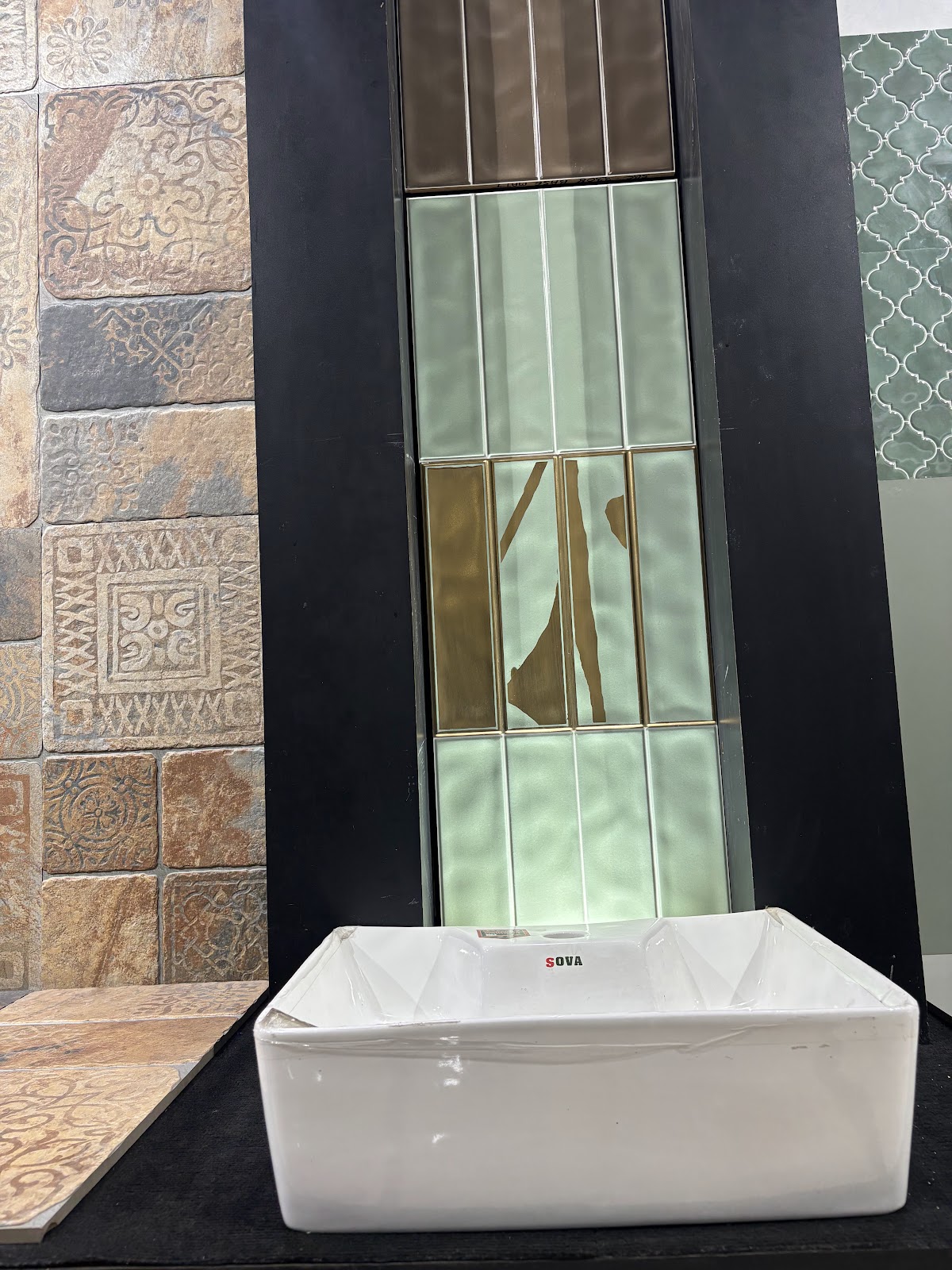
Bathroom walls are the second most common application, and arguably the best use of the 6 mm slab. Three pieces of 1200x2400 clad a shower with no joint at eye level, and a book matched pair behind a freestanding tub is the single most photographed thing we sell. Floors in a bathroom should be a matt or grainy finish with an R10 or R11 slip rating, which the stone and concrete families provide; keep the lappato for the walls.
Kitchen counters in 9 mm slab have become a genuine alternative to quartz and granite over the last two years. The slab is bonded to a plywood or cement board substrate, the front edge is mitred so the counter looks 20 or 40 mm thick, and the same slab continues up the wall as a backsplash without a joint. Porcelain does not stain from turmeric, does not scorch from a hot kadhai and needs no sealing. See the kitchen page for how this pairs with an Elica chimney and a Whirlpool appliance run.
Facades and commercial lobbies are the two places where Nexion competes with imported product directly. Thin slabs on ventilated fixing systems handle Delhi heat, monsoon and dust because porcelain does not absorb, fade or need repainting; the outdoor collection covers the thicker paving products that go with them. For lobbies, reception walls and office cores the commercial page and our large format lobby project in Delhi NCR show what the concrete and marble families look like at scale, under the lighting a real building has.
Why the slabs are shown full size at Sector 9
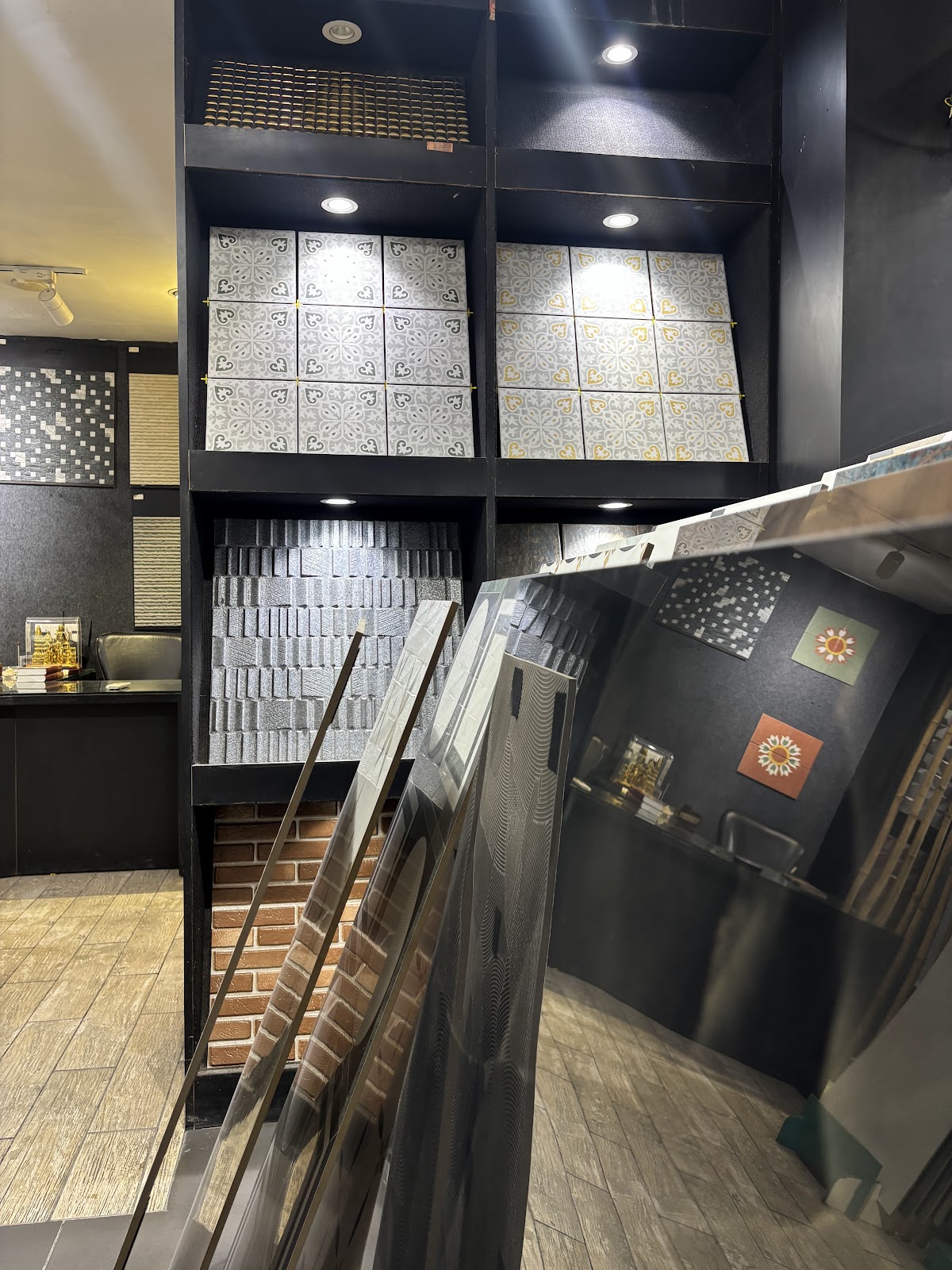
Most tile shops in Delhi NCR sell Nexion from a 300 mm sample board or from the catalogue on a tablet. We took a different decision and built racks for full 1200x2400 slabs across the four families, standing upright under a mix of daylight and warm LED. It costs floor space and it means we cannot stock every series, but it changes the quality of the decision a customer makes.
A sample cannot show three things. It cannot show how a vein behaves over 2.4 metres, which is the whole point of a slab. It cannot show gloss, because a lappato surface reads completely differently at 300 mm than it does as a wall reflecting a window. And it cannot show colour drift across a series, where the fourth and fifth faces of a marble are warmer or greyer than the one on the sample board. We have seen customers reject a surface they loved on the tablet within thirty seconds of seeing the full slab, and the reverse, and both are the right outcome before a lakh of material is ordered.
Lead times, ordering and care
Surfaces we hold at Sector 9 or at Bawana can be delivered in Noida within a few days, usually on a small truck with a two man crew to carry slabs into a ground floor or lift building. Sizes and finishes that need to come from the Morbi plant take two to four weeks, and a specific book matched set, where the pairs must come from consecutive slabs in one lot, can take longer. The practical advice is to finalise the surface before the plumbing is closed so that the slabs arrive when the screed is ready rather than sitting in a bedroom for a month.
Quantity is calculated from the layout drawing, not from the room area. A 1200x2400 slab that must be cut around a door reveal and a kitchen island can lose 20 percent of its area, so we draw the layout, count the pieces, and add 8 to 12 percent for cuts and one spare slab per room stored flat for the day a dropped pressure cooker chips a corner. Everything in one order comes from one production lot, which matters for marble finishes where shade varies between batches. Payment is usually an advance against the order with the balance before delivery; GST invoices are standard.
Care is the easy part. A polished porcelain slab is cleaned with water and a neutral floor cleaner; no acids, no phenyl at full strength, no wire scrubbers on a lappato surface. Grout is where floors age, which is why we specify epoxy grout in kitchens and bathrooms and a high quality cement grout in a matching shade elsewhere. Nothing needs sealing. A matt stone or concrete surface will happily take ten years of a Noida household and the annual Diwali deep clean without showing it.
Nexion against imported Italian slabs and against standard GVT
The two comparisons customers ask for most are with Italian slabs at the top and with a good Morbi glazed vitrified tile at the bottom. The table is how we summarise both on the counter.
| Point of comparison | Standard Morbi GVT, 600x600 to 800x1600 | Nexion slab | Imported Italian slab |
|---|---|---|---|
| Material price, Rs per sq ft | 45 to 110 | 150 to 600 and above | 450 to 1,200 and above |
| Maximum size | 800x1600 for most plants | 1200x2400 | 1200x2400 and 1600x3200 |
| Thickness | 9 to 10 mm | 6 and 9 mm | 6, 12 and 20 mm common |
| Unique faces per series | 4 to 8 typical | Dozens, book match available | Dozens, book match available |
| Lead time in Noida | Ex stock | Ex stock to 4 weeks | 8 to 14 weeks, exchange rate risk |
| Replacement and matching later | Easy | Realistic within a few years | Difficult, keep spares |
| Best suited to | Bedrooms, rentals, budget floors | Living, bathroom walls, counters, lobbies | Signature walls where the specific quarry look is the brief |
The honest summary is that Nexion sits closer to the Italian product than to the GVT in every column except price, where it sits closer to the GVT. That gap is the reason the brand exists. There are still jobs where an imported slab is right: a client who has fallen for one particular Italian series, or a project that needs 1600x3200 or a 20 mm body. There are far more jobs where a Morbi GVT is right, because the room is a bedroom and nobody will ever look at the floor. Nexion is for the rooms in between, which in most Noida homes means the living area, the master bathroom and the kitchen.
How to choose: a short decision path
Start with the room and the light. If the surface is a living floor or a large wall that gets daylight, Nexion will reward you and the question becomes which family. Pick marble finish if the brief is bright and formal, stone if it is calm and forgiving of dust, concrete if it is contemporary or commercial, and wood finish planks if you want warmth underfoot in a bedroom or study. Then pick the size from the longest clear run: 800x1600 under 3 metres, 1200x2400 above 4, and either in between depending on how many cuts the plan shows. Match the finish to the use, lappato on walls and formal floors, naturale or grainy on anything that gets wet. Confirm 9 mm for floors and counters, 6 mm for walls. Then come and stand in front of the slab at our Sector 9 showroom with the floor plan, because the last five percent of the decision, the one about how a vein turns a corner, cannot be made from a screen. If the room is a bedroom, a rental or a store, save the money and we will show you a good 600x1200 instead.
Frequently asked questions
Who makes Nexion tiles and where are they manufactured?
Nexion is an Indian premium porcelain slab brand set up in 2015 as a joint venture between Ceramiche Speranza of Italy, a ceramics house dating from 1961, and an established Morbi manufacturing group. The slabs are pressed and fired at a dedicated plant in Morbi, Gujarat, with design direction from Italy. The company is headquartered in Ahmedabad.
What sizes do Nexion tiles come in?
The standard Nexion grid runs from 300x600 and 600x600 through 600x1200, 800x1600, 1200x1200 and 1200x1800 up to the 1200x2400 mm slab, plus a 200x1200 plank format for wood finishes. Slabs are produced mainly in 6 mm and 9 mm. Larger 1600x3200 and 20 mm products are special order items from the wider slab market.
What is the price of Nexion tiles per sq ft in Noida?
As showroom ranges that move with the season, Nexion 600x1200 and 800x1600 pieces sit roughly between Rs 150 and 280 per sq ft, 1200x1200 and 1200x1800 between Rs 220 and 400, and 1200x2400 slabs between Rs 280 and 600 or more for full lappato marble finishes. All figures exclude GST at 18 percent, adhesive and labour.
Is Nexion better than a normal vitrified tile from Morbi?
It is a different product rather than a better version of the same one. Nexion slabs are pressed at far higher force, fired above 1200 degrees, printed at higher resolution with deeper vein reproduction and offered in book matched pairs. A standard 600x600 GVT remains the sensible floor for a bedroom or a rental; Nexion earns its price in rooms where the surface is on show.
Can Nexion slabs be used as a kitchen countertop?
Yes. The 9 mm 1200x2400 slab is regularly cut for counters and islands in Noida kitchens, usually bonded to a plywood or cement board substrate with a mitred front edge for a thicker look. Porcelain does not stain from turmeric or oil, takes a hot kadhai without marking and does not need sealing, unlike marble or granite.
How long does it take to get Nexion tiles delivered in Noida?
Surfaces we hold in stock at Sector 9 or at our Bawana warehouse can be delivered within a few days. Sizes and finishes that need to come from the Morbi plant generally take two to four weeks, and a specific book matched batch can take longer. Confirm quantities with a 10 percent margin before the order is placed so the whole job comes from one lot.
Do Nexion tiles need special installation?
Slabs need a flat substrate, a C2 S1 polymer modified adhesive applied to both floor and tile back, levelling clips, a 2 to 3 mm joint and a crew that has laid 1200x2400 before. 600x1200 and 800x1600 Nexion pieces are laid like any rectified porcelain. Cement and sand mortar is not suitable for any of them.
Where can I see Nexion tiles in Noida?
World of Tile at A/17, Sector 9, Noida holds Nexion marble finish, stone, concrete and wood finish surfaces as full 1200x2400 slabs on display, open daily from 10:30 AM to 8:00 PM. Bring your floor plan and the team will lay out sizes, wastage and an installed estimate on the spot.
Stand in front of the slab before you order it. World of Tile holds Nexion marble finish, stone, concrete and wood finish surfaces as full 1200x2400 slabs at A/17, Sector 9, Noida, open every day from 10:30 AM to 8:00 PM. Bring your floor plan and we will draw the layout, count the pieces and give you an installed estimate the same afternoon.
Plan a showroom visit Message on WhatsApp