
Marble Look Porcelain vs Italian Marble in Delhi NCR: Price, Maintenance and Looks
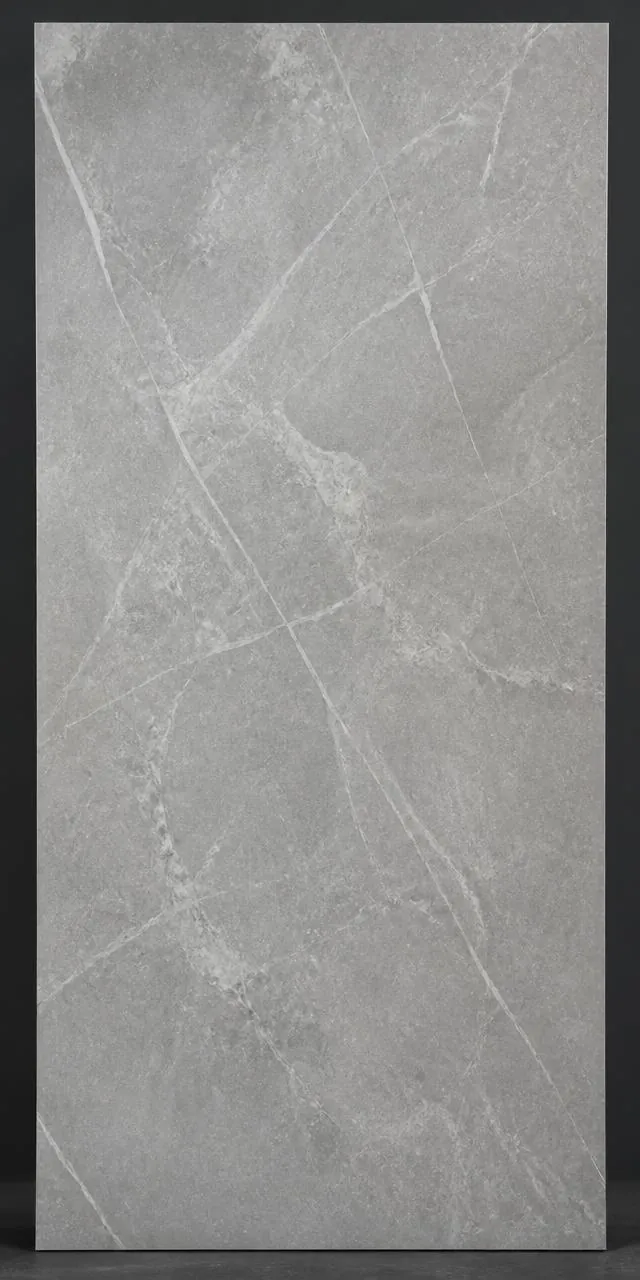
A couple came into the Noida showroom last month with a photograph of a Statuario floor from a relative's house in Vasant Vihar and a quotation for the same stone from a yard in Kishangarh. They wanted to know if our marble finish porcelain could give them that floor for less. The honest answer took forty minutes and involved a lemon, a sample of real marble and a slab of Nexion laid side by side on the counter. This article is that conversation written down: what Italian marble costs in Delhi today, what it costs over ten years, how close porcelain now gets, where it still falls short, and how to decide for your own home.
What Italian marble costs in Delhi right now
Italian marble in Delhi is sold by the sq ft from yards in Kishangarh, Mangolpuri and along the Gurgaon road, and the price on the slab is only the start. The stone arrives as blocks or as 18 to 20 mm slabs, is cut to size, laid on a thick mortar bed, ground flat with progressively finer diamond pads, polished, and finally sealed. Every one of those steps is a separate line on the bill. The ranges below are what customers report to us this season, and they move with the euro, with the quarry lot and with the honesty of the yard, so treat them as ranges rather than quotes.
Statuario and Calacatta
These are the two names everyone asks for. Both are white marbles from the Carrara region with bold grey or gold veining, and both are scarce enough that price depends on the individual slab. Ordinary commercial Statuario in Delhi sits around Rs 350 to 700 per sq ft. Clean, bright material with dramatic veining goes to Rs 900 to 1,200 and select lots run well above that, especially for book matched pairs. Calacatta, with its warmer gold veins, generally sits at the upper end of the same band. A 1,200 sq ft flat floored in mid grade Statuario is a material bill of Rs 6 to 9 lakh before anyone has picked up a trowel.
Carrara and Botticino
Carrara is the softer, greyer, more finely veined cousin and it is the affordable end of Italian white, usually Rs 250 to 450 per sq ft in Delhi. Botticino is a beige marble from near Brescia that Indian builders used in lakhs of flats through the 2000s. It is the most forgiving of the four on price, roughly Rs 150 to 350 per sq ft, and also the one most often confused with Indian and Turkish beige stones sold under the same name. If a quotation for "Italian Botticino" is below Rs 150, ask which country the block came from.
What marble finish porcelain costs
Porcelain is priced per sq ft too, but the spread is a spread of manufacturers and sizes rather than of individual slabs, because every piece in a batch is identical. Indian made marble look glazed vitrified tiles in 600x1200 from Morbi start around Rs 90 per sq ft. Polished 800x1600 porcelain from the better Indian factories runs Rs 150 to 300. Full 1200x2400 slabs in the Italian influenced ranges we stock, such as Nexion, run roughly Rs 250 to 600 per sq ft depending on finish, thickness and whether the pattern is a standard face or a book matched pair. Everything carries GST at 18 percent.
On top of material, a porcelain floor needs polymer modified adhesive, grout and a skilled crew, which in Noida adds Rs 45 to 90 per sq ft for slabs. We have written a full breakdown of these numbers in our Noida tile price guide, so here it is enough to say that even the most expensive porcelain slab, laid, lands near the price of the cheapest Italian marble before that marble has been polished. That is the first thing the price comparison tells you. The second is in the next ten years.
The ten year cost, honestly
Marble is a living surface, and the bill for keeping it alive is the part that never appears on the yard's quotation. The first polish after laying is unavoidable, because slabs are ground flat in place to remove lippage between pieces. That grinding and polishing costs Rs 30 to 60 per sq ft in Delhi and takes a crew with a floor machine several days, during which the flat is unusable and the RWA hears about the noise. Sealing follows at Rs 10 to 20 per sq ft, and a penetrating sealer needs renewing every one to two years if the floor is to resist stains at all.
Then there is the Indian kitchen. Marble is calcium carbonate. Lemon, vinegar, tamarind, cola and most bathroom cleaners etch the polish in minutes, leaving a dull ring where the drop sat. Haldi, tea, mustard oil and mehndi do the opposite: they soak into the pores and leave a shadow that sealing slows but rarely prevents. Iron minerals inside white marble oxidise with moisture, and in a Delhi monsoon the moisture rising through a cement mortar bed is enough to turn a bright Statuario floor faintly yellow within a few years. Some of this grinds out at the next re-polish. Some of it does not.
Re-polishing is therefore not optional. A family floor in Delhi wants it every three to five years, at Rs 25 to 50 per sq ft each time, which over a decade means two or three more rounds of machines, slurry and evacuated rooms. Porcelain has none of these lines. It is fired to under 0.5 percent water absorption, the surface is a glaze or a through polished ceramic, and a decade of haldi and lemon leaves it exactly as it was laid. The table puts the two side by side per sq ft, all figures being moving ranges for Delhi NCR.
| Cost line (Rs per sq ft) | Italian marble, Statuario grade | Marble finish porcelain, 800x1600 to 1200x2400 |
|---|---|---|
| Material | 350 to 1,200 and above | 90 to 600 |
| Laying (mortar bed or adhesive, labour) | 60 to 90 | 45 to 90 |
| First grinding and polishing | 30 to 60 | Nil |
| Sealing at start, renewed every 1 to 2 years | 10 to 20, then 30 to 80 over the decade | Nil (epoxy grout optional) |
| Re-polishing, two to three rounds in ten years | 50 to 150 | Nil |
| Ten year total, approximate | 530 to 1,600 and above | 135 to 690 |
Two things are missing from the table and both favour porcelain. The first is wastage: marble slabs are irregular and veined, so 12 to 15 percent extra is normal, against 7 to 10 percent for a well planned slab layout. The second is the cost of living with the work. A marble re-polish means moving every piece of furniture out of the room and living with wet slurry for days, in a flat where the family still has to eat and sleep. That cost is real even though it is not in rupees.
How close the look now gets
What digital printing changed
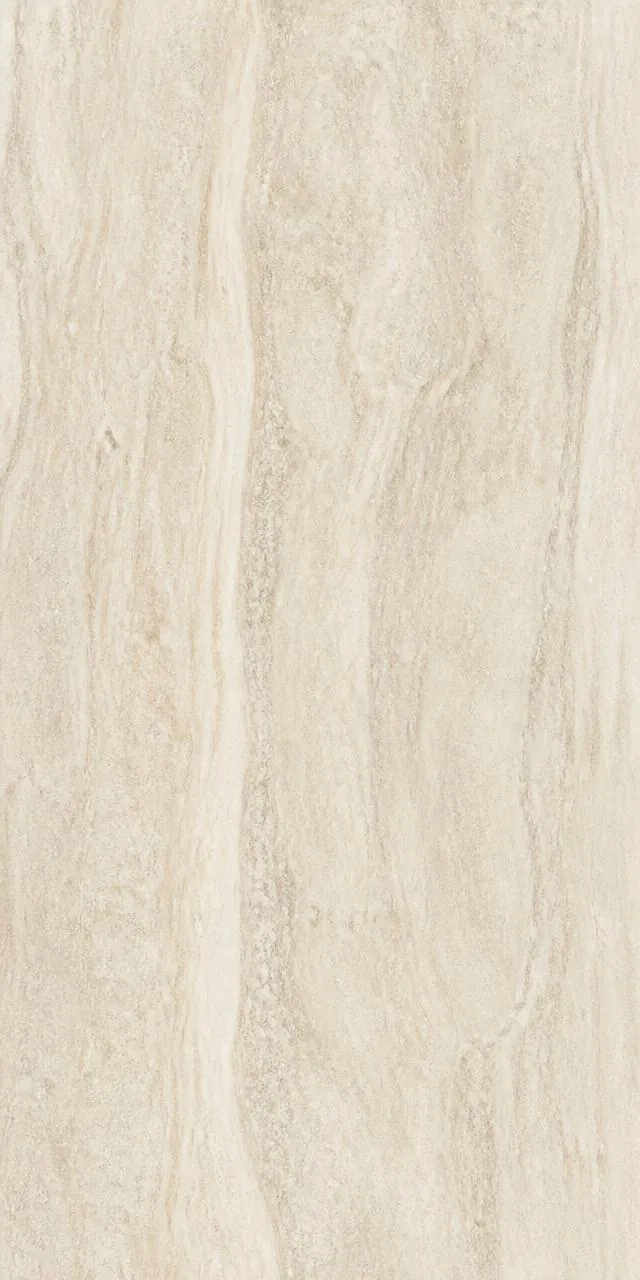
Ten years ago a marble look tile was a small repeating picture, and you could spot the repeat from across the room. Today a factory scans a real marble slab at high resolution, prints it with inkjet heads onto the porcelain body before firing, and adds a second pass of glaze and structure so that the polish, the faint texture along the vein and the subtle satin of a honed finish are all reproduced. Manufacturers now ship a single pattern with dozens of different faces across a batch, so a 200 sq ft room may have no two identical tiles. On a 1200x2400 slab the print runs the full 2.4 metres without a break, which is the scale at which marble veining actually lives. A visitor standing in the doorway of a well laid porcelain floor will, in our experience, assume it is stone.
Book matching in porcelain
Book matching was once the surest sign of real marble: two consecutive slices from the same block opened like a book so that the vein meets itself in a mirror image. The larger porcelain manufacturers now print mirrored pairs of slabs, sometimes four way sets, so that a shower wall or a living room feature wall can carry the same symmetrical figure. Our large format collection is shown as full slabs partly for this reason, because book matching only reads properly at full size. The marble look bathroom suite we supplied in Noida used a book matched pair behind the vanity and single faces elsewhere, and the result is difficult to tell from stone in a photograph.
Where porcelain still falls short
Three things give the game away up close, and it is only fair to name them. The first is translucency. Light enters real marble a millimetre or two before bouncing back, which gives white stone a soft inner glow, most visible in morning light on a floor or on a lit pooja shelf. Porcelain is opaque and the glaze sits on top, so the surface is brilliant but flat. The second is edge detail. Cut through a marble slab and the vein continues through the thickness, so a stair nosing, a basin counter edge or a mitred corner shows stone all the way round. Cut through a glazed porcelain tile and the edge is a plain white or grey body unless you specify a full body slab or have the edges mitred and the pattern carried round, both of which cost more.
The third is randomness. A batch of porcelain has many faces but a finite number, and on a very large floor a trained eye will eventually find the same fold of vein twice. Real marble never repeats, and its flaws, its dull patches and iron spots and healed cracks, are what make it feel alive to people who love it. Porcelain is cleaner than marble, and for some customers that cleanness is precisely the thing that looks slightly wrong. This is a matter of taste rather than quality, and the only way to settle it is to look at both in daylight.
Thickness, weight and floor loading in a flat
Italian marble is supplied at 18 to 20 mm and is laid in Delhi on a bed of cement and sand mortar 40 to 50 mm thick, because slabs are never perfectly flat and the bed takes up the difference. Stone at that thickness weighs about 50 kg per sq m, and the mortar underneath weighs more than the stone, so a finished marble floor loads the structure at roughly 130 to 150 kg per sq m. A 9 mm porcelain tile weighs about 20 kg per sq m and its adhesive bed adds 8 to 10 kg, so the whole floor is 25 to 30 kg per sq m. A 6 mm slab on a wall is lighter again.
Weight is rarely the deciding factor in a modern RCC building, because structural engineers allow for the dead load of a stone floor finish as a matter of course. The practical problem is height. A marble floor raises the level by 60 to 70 mm, which in a renovation means either chipping out the existing floor down to the slab, with all the debris that involves, or losing that height at every door, wardrobe and balcony threshold. Porcelain laid over an existing sound floor adds 12 to 15 mm. In a builder floor or an older DDA flat where nobody is certain what is under the present tiles, that difference alone often settles the argument. Handling matters as well: a 20 mm marble slab of 4x8 ft weighs close to 150 kg and needs four men and a cleared stairwell, while a 1200x2400 porcelain slab at 6 mm is under 45 kg and travels with two men and a suction frame.
Installation: two different trades
Marble laying in Delhi is a stone trade. The mason spreads a mortar bed, wets the back of the slab, taps it level with a mallet, and repeats, and because no two slabs are the same thickness the floor is laid slightly proud and then ground flat as one surface. Joints are kept as tight as possible and filled with matching resin or cement. The floor cannot be walked on for several days and cannot be ground for a week or two while the bed cures. Then comes the polishing crew, the water, the slurry and the sealer. A 1,200 sq ft flat is a three to four week job before it is furniture ready.
Porcelain laying is a tile trade and a faster one. The floor is checked with a straight edge and levelled if it fails, a polymer modified adhesive of C2 grade or better is combed onto the floor and onto the back of the tile, levelling clips pull neighbouring edges flush, and 2 mm joints are grouted after a day. Because every tile is the same thickness, there is no grinding stage and no slurry. The same flat is walkable in two days and furnished within a week. We have written up the adhesive side of this in detail in our tile adhesive versus cement article, and the slab handling rules in the large format guide, so we will not repeat them here. The short version is that the wrong crew can ruin either material, and that the porcelain crew is easier to find and to check.
Standards help with the checking. Marble sold in India is covered by the Bureau of Indian Standards specification for marble blocks, slabs and tiles, and porcelain by IS 13006, which aligns with the international ceramic tile classification; both are published by BIS. Asking a yard or a tile dealer to confirm the grade under those standards is a reasonable request and a surprising number of sellers cannot answer it.
Side by side, and when each one wins
| Question | Italian marble | Marble finish porcelain |
|---|---|---|
| Material price, Delhi (moving range) | Rs 350 to 1,200 plus per sq ft for Statuario and Calacatta; Carrara and Botticino lower | Rs 90 to 600 per sq ft |
| Ten year upkeep | Sealing, two to three re-polishes, stain risk | Mopping |
| Stains from haldi, lemon, oil | Etches and absorbs; needs quick wiping and sealing | No absorption; wipes clean |
| Yellowing | Possible with moisture and iron content | None |
| Look from standing height | Stone | Very close to stone on a good slab |
| Look up close and at edges | Depth, glow, vein through the thickness | Flat surface, plain body at cut edges unless full body |
| Randomness | Never repeats | Many faces per batch; can repeat on very large floors |
| Book matching | Yes, from consecutive slabs | Yes, printed mirrored pairs |
| Thickness and floor build up | 18 to 20 mm plus 40 to 50 mm bed | 6 to 12 mm plus 3 to 5 mm adhesive |
| Weight on the floor | 130 to 150 kg per sq m | 25 to 30 kg per sq m |
| Time to furniture ready, 1,200 sq ft | Three to four weeks | About a week |
| Slip when wet, polished finish | Slippery | Slippery; choose matt or honed for bathrooms |
| Resale and prestige | High in premium addresses | Neutral; buyers rarely notice |
When real marble is the right answer
There are homes where we tell people to go and buy the stone. A pooja room is the first: the surface is touched, sat upon, lit by a diya and looked at from a foot away, and the glow of real marble is part of what the room is for. Heritage homes and older bungalows in Delhi, where the rest of the house is stone and the floors are part of its value, are the second. Feature pieces are the third: a single book matched wall behind a dining table, a staircase with solid nosings, a basin counter with a mitred edge, a threshold slab at the front door. In these places the quantity is small, the upkeep is manageable and the material is doing the job nothing else can. The buyer who genuinely enjoys the ageing of stone, who does not mind the odd etch mark and sees the yearly sealing as care rather than cost, is also right to choose marble.
When porcelain is the wiser buy
For the general floor of a Delhi NCR flat, porcelain wins on nearly every line of the table. It wins in kitchens without argument, because the kadhai, the haldi and the lemon will attack marble every single day. It wins in bathrooms because it does not absorb water, does not yellow behind a wet wall, and can be had in a honed or matt marble finish with a proper slip rating, which polished marble cannot. It wins on upper floors and in renovations where floor height and debris matter, on tight schedules, and for anyone who will rent the flat out and cannot supervise how tenants treat the floor. And it wins for the family that wants the Statuario look at Rs 250 to 600 per sq ft instead of Rs 900, and would rather spend the difference on a Kohler or Jaquar bathroom than on a polishing contract.
How to choose: a short decision path
Start with the room and the distance. If the surface is a floor or a wall that will be seen from standing height, and it will meet food, water or children, porcelain is the default and you should only leave that default for a specific reason. If the surface is a small area that is touched, lit and looked at up close, a pooja mandir, a staircase, a counter or a single feature wall, put real marble on the shortlist and price it for that area alone rather than for the whole flat. Next, look at the building. Any doubt about floor height at doors, about carrying slabs up without a lift, or about what is beneath the present floor pushes you toward porcelain. Then ask yourself honestly about upkeep. If sealing every year and re-polishing every few years sounds like a chore, it will be, and the stone will show it. If it sounds like caring for something you love, marble may be right.
Only then choose the pattern. Bring the photograph of the floor you admire and hold a real marble offcut beside the porcelain slab that comes closest to it, in daylight, at the distance you will actually see it from. Check the porcelain for a polished, honed or matt surface as the room requires, confirm the body is porcelain with rectified edges, and ask how many faces the batch carries and whether a book matched pair is available. If the answer is that porcelain gets you nine tenths of the way at a third of the ten year cost, that is most of our customers. If the answer is that only the stone will do, buy the stone for that one place and put porcelain everywhere else. Either way, come and see both at our Sector 9 showroom in Noida, where the lemon test is free.
Frequently asked questions
What is the price of Italian marble per sq ft in Delhi?
In Delhi the white Italian stones that most families ask for, Statuario and Calacatta, sell for roughly Rs 350 to 1,200 per sq ft and beyond for select slabs. Carrara sits lower and Botticino lower still. These are moving ranges: they change with the euro, with the quarry lot and with slab quality. Laying, grinding, polishing and sealing are all extra.
How much do marble look porcelain tiles cost in Delhi NCR?
Indian made marble finish vitrified tiles in 600x1200 start around Rs 90 per sq ft. Premium 800x1600 porcelain runs Rs 150 to 300, and imported style 1200x2400 slabs such as Nexion range from roughly Rs 250 to 600 per sq ft. Add Rs 45 to 90 per sq ft for adhesive, grout and skilled labour. All of these move with the season.
Can marble look tiles really look like Italian marble?
From standing height, yes, and a good 1200x2400 slab with book matching fools most visitors. The gap shows up close: real marble has depth and a faint glow because light enters the stone, and its edges and veins are never repeated. Porcelain prints the surface, so translucency and true randomness are where it still falls short.
Does Italian marble stain from haldi, lemon and tea in an Indian kitchen?
Yes. Marble is calcium carbonate, so lemon, vinegar, tamarind and cola etch the polish within minutes, and haldi, tea and oil sink into the pores and leave shadows. Sealing slows this down but does not stop it. Glazed porcelain does not absorb, so the same spill wipes off without a mark.
Why does white Italian marble turn yellow in Delhi homes?
Three common causes: iron minerals inside the stone oxidising with moisture, moisture rising through a cement mortar bed during monsoon, and acidic cleaners dulling the polish so the surface looks tired. Some yellowing can be ground out at the next re-polish, some is permanent. Porcelain has no minerals to oxidise and does not yellow.
Is Italian marble too heavy for an upper floor flat?
An RCC building is designed for the dead load of a stone floor, so weight alone rarely stops a marble installation. The practical problems are the 60 to 70 mm of floor height that a mortar bed adds, carrying 20 mm slabs up without a service lift, and RWA rules on grinding noise. Porcelain at 9 mm on adhesive is a fraction of the weight and thickness.
What are book match marble slabs and do porcelain slabs offer the same?
Book matching means placing two adjacent slabs as mirror images so the vein forms a symmetrical figure, like an open book. In marble this comes from consecutive slices of the same block. Large porcelain manufacturers now print mirrored pairs of 1200x2400 slabs for the same effect, so book matched walls are available in both materials.
When is real Italian marble the better choice over porcelain?
Choose real marble for a pooja room, a heritage or high value home where the stone is part of the value, a feature wall or a staircase that is seen up close and touched, and any owner who genuinely enjoys the ageing and upkeep. For general floors in a Delhi NCR flat, kitchens and bathrooms, marble look porcelain is usually the wiser buy.
Put the stone and the slab side by side before you spend nine lakh on either. World of Tile keeps full 1200x2400 marble finish slabs from Nexion and other ranges, plus a real marble offcut for comparison, at A/17, Sector 9, Noida, open every day from 10:30 AM to 8:00 PM. Bring your floor plan and the yard's quotation and we will work out the ten year figure for both on the spot.
Plan a showroom visit Message on WhatsApp