
Tile Adhesive vs Cement: What MYK Laticrete and Kerakoll Change on Site
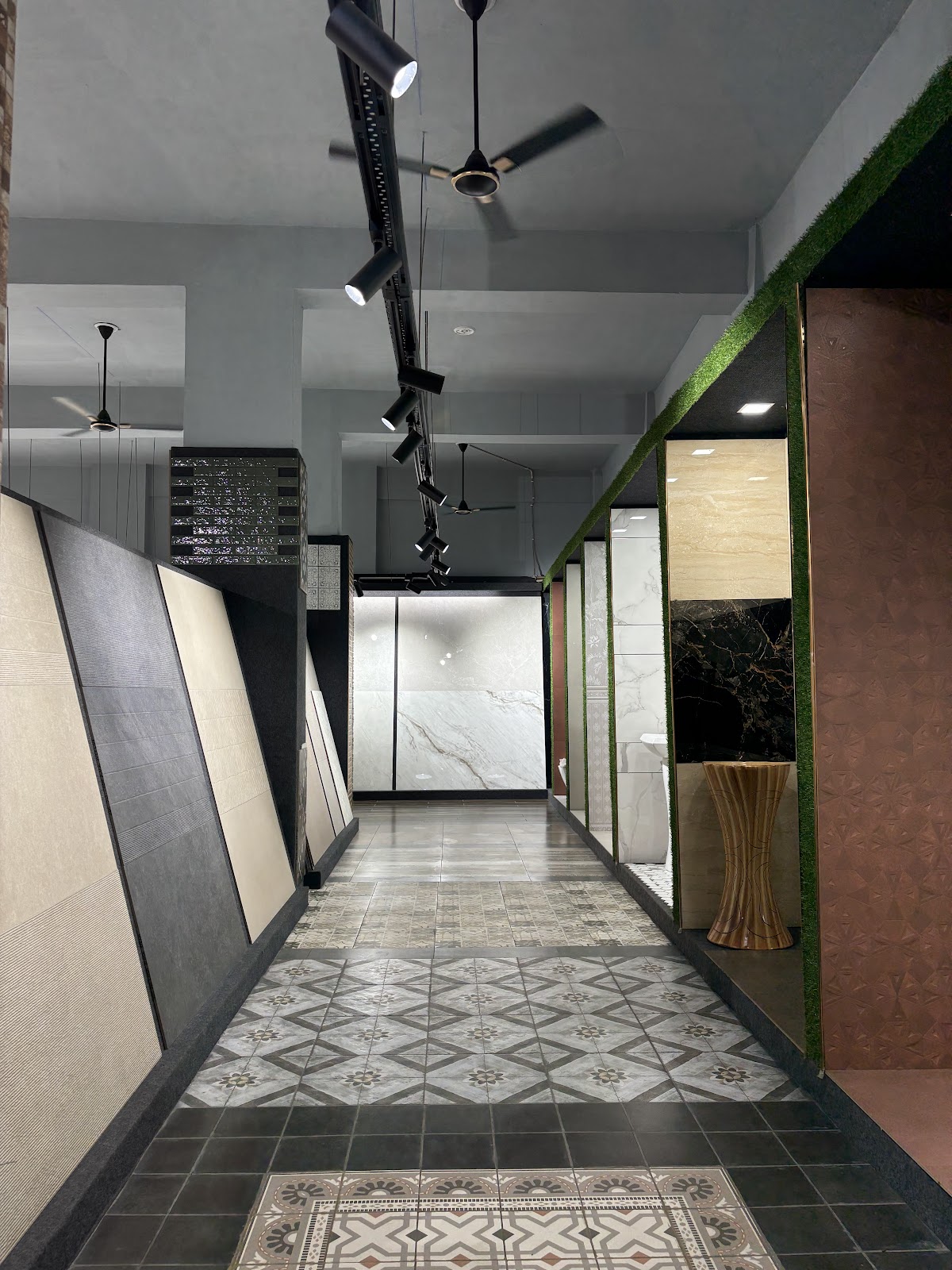
At least once a week a customer brings a loose tile into our Noida showroom in a plastic bag. The back is clean. There is a faint grey dust where the cement was meant to be, and a few ridges of mortar that never touched the tile at all. The floor is usually three to five years old, the tile is usually vitrified, and the mason usually did exactly what he was taught in the 1990s. Nothing about the tile was wrong. The material under it was. This is the conversation we have across the counter about why cement and sand stopped being good enough, what the letters on an adhesive bag actually mean, and what MYK Laticrete and Kerakoll change about the way a floor goes down.
Why cement and sand mortar fails under vitrified and porcelain
Cement mortar was a fine bedding for the tiles India used to buy. A red clay tile or an old ceramic wall tile absorbs 10 to 20 percent of its weight in water. When it is soaked and pressed into wet mortar, cement paste is drawn into the open pores of the biscuit and the two harden together. That suction is the bond. Nobody added a chemical to make it stick because the tile itself did the work.
A vitrified tile absorbs under 0.5 percent, and a porcelain slab from a brand like Nexion is often closer to 0.1. There are no pores for paste to enter, and the back of a modern tile is a smooth, machine pressed surface with a shallow grid that gives cement nothing to grip. The mortar cures against the tile, not into it. It holds by friction and by the weight of the floor above it, which is why the tiles in the kitchen and passage come loose first: they see the most foot traffic and the most washing. We covered how absorption is measured in our piece on vitrified, porcelain and ceramic tiles, and the same number that makes a tile easy to clean is the number that makes cement fail beneath it.
The second problem is contact. A thick bed of mortar is placed by hand in a heap and the tile is tapped down until it sits level. That produces high spots where the mortar is compressed and pockets where it never reached the tile. Tap a cement laid vitrified floor with a coin and you will find those hollows, and a hollow is where the tile cracks the first time a wardrobe leg or a gas cylinder lands on it. The third is moisture. Wet mortar under a tile dries slowly and unevenly, and on lighter shades of glazed vitrified it shows through as patches and shade variation that appear months after the customer has paid, and that no amount of cleaning removes.
What a polymer modified adhesive actually is
A tile adhesive is still mostly cement. Into it the manufacturer blends graded sand, a cellulose ether that holds water in the mix so the cement can cure fully in a thin layer, and a redispersible polymer powder, usually based on vinyl acetate or acrylic. When the bag is mixed with water the polymer forms a film through the cement matrix. That film is what changes everything. It bonds to non porous surfaces by adhesion rather than suction, it lets the cured bed flex a little without cracking, and it holds water long enough for the cement to hydrate even in a 3 mm layer under a slab that is sitting in the sun.
The practical difference on site is that adhesive is spread thin with a notched trowel rather than heaped, the tile is pressed rather than tapped, and the bed reaches 90 percent or more of the back of the tile instead of the 50 to 60 percent that a good mason achieves with mortar. The adhesive itself costs more per bag than cement, but far less of it is used, and the floor that results is one you do not have to think about for twenty years. Both MYK Laticrete and Kerakoll publish the class, the coverage and the open time for every bag, which is more than anyone can say for a sack of OPC and a lorry of Badarpur sand.
The IS 15477 and EN 12004 classes in plain words
Two standards govern the bags you will see in Noida. The Indian one is IS 15477, published by the Bureau of Indian Standards and revised in 2019, and it sorts adhesives into numbered types by what they are meant to stick to. Type 1 is for absorbent ceramic and clay tiles on cement surfaces indoors. Type 2 is for tiles with absorption of 3 percent or less, which means every vitrified and porcelain tile, and it is rated for floors, walls and exterior work. Type 3 covers exterior walls and heavier or trickier materials such as natural stone and basalt. Type 4 is for board substrates like gypsum, plywood and fibre cement, and a further Type 5 covers resin based adhesives. The Indian standard adds T for slip resistance on walls and S1 or S2 for deformability, borrowing the European letters so that a bag can be read in either system.
The European standard, EN 12004, is the one printed on most premium bags and it is easier to decode. The first letter tells you the base: C for cementitious, D for a ready mixed dispersion paste, R for a reaction resin such as epoxy. The number that follows is bond strength. A C1 must hold 0.5 newtons per square millimetre in the tensile test, a C2 must hold 1.0, which is double. Then come optional letters. T means the adhesive is thixotropic enough that a wall tile slips less than half a millimetre before it grabs, so you can tile a wall from the top down without battens. E means extended open time, 30 minutes in the laboratory instead of the 20 of a standard grade. F means fast setting, with usable strength inside six hours, which is useful for a commercial fit out that must reopen the next morning.
The S classes describe how much the cured adhesive can bend before it lets go. S1 is deformable, tested to 2.5 mm of flex across a strip of adhesive. S2 is highly deformable, tested to 5 mm. A bag marked C2 T E S1 is therefore a cement based adhesive with double bond strength, low slip, long open time and enough flexibility for large tiles and outdoor work. That string is the one to look for on almost any porcelain job in Delhi NCR, and it is the string that appears on the large format families from both brands we stock.
Which class for which tile and substrate
The class you need follows from the tile, the surface underneath and where the room is. A plain ceramic wall tile in a dry bedroom cupboard is genuinely fine on a C1, and there is no reason to spend more. The moment the tile is vitrified, the floor is a C2 job. Interior floors up to 600x600 on a sound cement screed are the plain C2 case. Walls in any size want C2 T, because slip on a wall shows as a crooked course three tiles up, and a 600x1200 on a bathroom wall has real weight to hold while the bed sets.
Large format, meaning anything with a side of 600 mm or more, moves up to C2 T E S1. The E buys the mason time to back butter and position a heavy tile, and the S1 lets the bed absorb the difference in expansion between a metre of porcelain and the concrete slab it sits on. Our guide to large format tiles and their drawbacks goes through the flatness and handling rules that go with that class. Exterior floors, terraces and facades want C2 S1 at least and often S2, because they take direct sun, monsoon soaking and a 30 degree swing between a January night and a June afternoon. Tile over existing tile is a C2 S1 job on a floor that has been checked for hollows and degreased, and a primer from the same brand is cheap insurance on a very glossy old surface.
Glass mosaic is its own case. Glass is transparent, so a grey adhesive shows through and dulls the colour; a white C2 T is used, and because glass expands more than porcelain an S1 grade is safer for a shower wall or a pool. Natural stone, and especially light marble, needs a white, fast setting, low water adhesive so that moisture does not stain the stone from the back. Gypsum board and plywood need a Type 4 or an adhesive the manufacturer specifically rates for boards, and the board itself must be primed.
| Situation | Cement sand mortar | Minimum adhesive class | What goes wrong with less |
|---|---|---|---|
| Ceramic wall tile, dry interior | Works, but slow | C1 or C1 T | Very little; this is the one case where cement is acceptable |
| Vitrified floor up to 600x600 | Hollow spots, loose tiles in 3 to 5 years | C2 | Debonding, cracked grout, shade patches on light tiles |
| Vitrified or porcelain wall tile | Slips, heavy tiles sag | C2 T | Crooked courses, tiles dropping off in bathrooms |
| Large format 600x1200 and above | Not suitable | C2 T E S1 | Cracking from stress at hollows, lippage, tiles lifting at edges |
| Terrace, balcony, facade | Not suitable | C2 S1 or S2 | Thermal cycling breaks the bond within a few seasons |
| Tile over existing tile | Will not bond | C2 S1 with primer | New floor lifts as a sheet |
| Glass mosaic, pool, shower feature | Shows grey through glass | White C2 T S1 | Dull colour, cracked tesserae |
| Kitchen counter or heavy traffic commercial | Not suitable | C2 S1, epoxy grout | Stained joints, bond failure under point loads |
Thin bed, thick bed, back buttering and trowel size
The old mortar method is a thick bed: 20 to 40 mm of cement and sand laid wet, doing two jobs at once, levelling the floor and holding the tile. That is why so many builder floor screeds are uneven, because nobody ever expected them to be flat; the mortar was going to fix it. Adhesive is a thin bed of 3 to 6 mm under standard tiles and 6 to 12 mm under slabs, and a thin bed cannot correct a floor. The screed must be flat to within 3 mm over a 2 metre straight edge before the first bag is opened, and if it is not, a levelling compound or a fresh screed comes first. This is the single change of habit that decides whether an adhesive job succeeds, and it is the one contractors most often try to skip.
The trowel is the measuring tool. A 6 mm square notch gives roughly a 3 mm bed once the tile is pressed, and that suits 300x300 and 600x600 on a good screed. A 10 mm notch suits 600x1200 and 800x800. A 12 mm notch, sometimes a half moon notch, is used under 1200x2400 slabs so the collapsed bed is thick enough to fill the slight bow that every large tile carries. Ridges are combed in one direction only, in straight lines, never in swirls, so that air can escape along the channels when the tile is pressed down and slid a centimetre across the ridges to collapse them.
Back buttering is a thin, flat skim of the same adhesive on the back of the tile, applied with the smooth edge of the trowel before the tile goes onto the combed bed. On a 300x300 ceramic it is optional. On anything vitrified above 600x600, on every exterior tile and on every slab, it is not, because it wets the back of the tile and closes the pockets that the ridges alone leave. The check is simple and we tell every customer to do it: lift the third tile of the day after it has been pressed and look at the back. Anything under 90 percent coverage indoors, or under 95 percent outdoors and in wet rooms, means the trowel is too small or the mason is skipping the butter.
Open time, Delhi heat and the mistakes we see most
Open time is the number that Delhi punishes. It is the period after adhesive is spread during which a tile pressed into it will still wet out and bond. In the laboratory a standard grade gives 20 minutes and an E grade 30, at 23 degrees and 50 percent humidity. On a roof terrace in Sector 9 in May, with the slab at 45 degrees and a dry wind, the adhesive can skin over in 8 to 10 minutes. The tile then sits on a dry crust, looks perfectly bonded, and lifts out clean a year later. This is the loose tile in the plastic bag.
The fixes are habits rather than products. Spread only what can be tiled in the next ten minutes, roughly a square metre at a time in summer. Touch the ridges with a fingertip before each tile: if adhesive does not transfer to the finger, scrape it up and spread fresh. Dampen a hot, dry screed with a sponge an hour before, without leaving standing water. Tile in the morning and the evening rather than through the afternoon on exterior work, and shade the area if the job allows. An E grade helps, and it is one reason we push the large format families of both brands even for 600x1200 in summer, but no bag survives an hour on a hot slab.
The other mistakes are familiar. Adhesive mixed too wet so it spreads easily, which halves its strength. Old adhesive re-tempered with water after it has begun to stiffen, which should be thrown away instead. Tiles soaked in water as if they were ceramic, which leaves a film that stops the polymer bonding. And the near universal one, no expansion joint at the doorway between rooms and none across a long run of floor, so the whole floor pushes against the walls in June and something has to give.
Coverage and what it costs per sq ft
These are ranges from what customers are paying in Noida this season, exclusive of GST at 18 percent, and they move with cement prices and the brand's list revisions, so treat them as a guide for a budget rather than a quote. A 20 kg bag of a C1 grade sits roughly between Rs 350 and 550. A C2 or C2 T from a reputed brand runs Rs 600 to 1,100. A C2 T E S1 large format grade runs Rs 1,100 to 2,000 a bag, and S2 and rapid setting grades sit above that. Our fuller breakdown of tile prices per sq ft in Noida puts these alongside the tile and labour numbers.
Coverage decides the cost more than the bag price. With a 6 mm trowel and no back buttering, a 20 kg bag covers about 45 to 55 sq ft. With a 10 mm trowel and back buttering it covers 25 to 35 sq ft. Under a 1200x2400 slab with a 12 mm trowel and full buttering it can drop to 18 to 25 sq ft. Run those numbers and adhesive material alone comes out at roughly Rs 8 to 12 per sq ft for a standard C2 job, Rs 15 to 25 for a large format or exterior job. Cement and sand for a thick bed costs Rs 4 to 8 per sq ft in material but takes more labour hours per sq ft, so the installed gap between the two is narrower than the bag price suggests.
| Bedding | Material per sq ft (moving range) | Typical labour, Noida | Installed extra over tile price | Where it belongs |
|---|---|---|---|---|
| Cement sand thick bed | Rs 4 to 8 | Rs 18 to 28 | Rs 22 to 36 | Absorbent ceramic only, or levelling under a screed |
| C1 adhesive, 6 mm trowel | Rs 6 to 10 | Rs 18 to 28 | Rs 24 to 38 | Ceramic walls and dry interiors |
| C2 or C2 T, 6 to 10 mm trowel | Rs 8 to 14 | Rs 20 to 32 | Rs 28 to 46 | Vitrified floors and walls up to 600x1200 |
| C2 T E S1 with back buttering | Rs 15 to 25 | Rs 35 to 60 | Rs 50 to 85 | Large format, exterior, tile on tile |
| Polymer cement grout | Rs 3 to 6 | included above | Rs 3 to 6 | Dry rooms, narrow joints |
| Epoxy grout | Rs 12 to 25 | Rs 8 to 15 extra | Rs 20 to 40 | Kitchens, bathrooms, counters, commercial |
The labour column is the honest part of the table. A mason who has only ever laid on mortar will quote a low rate and then use the adhesive like mortar, in heaps. The crews we recommend charge more per sq ft because they own the right trowels, a mixing paddle and levelling clips, and because they will refuse to lay on a screed that is not flat. That refusal is worth paying for.
Grout: cement or epoxy, colour and joint width
Grout does a small job with a large visual consequence. A polymer modified cement grout is a fine sand, cement and polymer mix, easy to apply, easy to clean off, available in thirty or forty colours, and porous. In a bathroom floor or behind a kitchen hob it darkens, harbours mould in the monsoon and, on a light floor, becomes the first thing a visitor notices. Sealers help for a year or two. Epoxy grout is a two part resin that does not absorb water, oil, turmeric or dye, and it cleans back to its original colour with a wipe. It costs several times more per sq ft, takes a practised hand because it must be washed off the tile face inside its working time, and in return it is the last time anyone thinks about those joints.
The split most of our customers settle on is epoxy in kitchens, bathrooms, utility areas and on any counter or commercial floor, with cement grout in bedrooms and living rooms where joints are 2 mm and traffic is clean. On joint width, rectified porcelain takes 2 to 3 mm, non rectified vitrified 3 to 4 mm, and outdoor or 20 mm thick porcelain 4 to 5 mm to give the S1 adhesive somewhere to move. A zero joint is not a thing; the tile has a tolerance and a Delhi summer has a coefficient of expansion. Colour is a design decision but a practical one too: matching the tile hides the grid, contrasting it draws a pattern, and a mid grey forgives more dirt than white or charcoal on a floor.
Spacers and levelling clips
Cross spacers of the right width go in every joint, and they come out before grouting. Levelling clips, the plastic wedge or screw cap systems, go under the joints of anything 600x1200 or larger and pull the edges of adjacent tiles flush while the adhesive sets. On a thick mortar bed a mason could tap a high tile down. On a 3 mm adhesive bed there is nowhere for it to go, so lippage has to be prevented rather than corrected, and clips are how. They add Rs 2 to 4 per sq ft and remove the most common reason a large format floor looks cheap.
MYK Laticrete and Kerakoll at World of Tile
We stock both brands because they answer slightly different questions, and because both give a mason a datasheet rather than a rumour. MYK Laticrete is the Indian arm of an American adhesive maker and its bags are made here, priced for Indian projects and marked in both IS 15477 types and EN 12004 classes. The families we carry cover a standard C2 grade for vitrified floors and walls, a large format grade in C2 T E S1 with the extended open time that summer demands, an exterior and heavy duty grade with S1 or S2 deformability for terraces and facades, and a matching range of polymer cement grouts and epoxy grouts in a wide colour card. Their system approach, with a primer, a waterproofing coat, the adhesive and the grout from one maker, is what we recommend for a builder floor bathroom that is being redone from the screed up.
Kerakoll is Italian, with a strong record on large format and on low emission, mineral based formulations, and it is the brand we reach for when the tile is a Nexion slab or an imported porcelain with a very flat, dense back. Its large format adhesives are C2 T E S1 and S2 grades with a lighter, more workable texture that spreads further per bag, its exterior grades are built for the freeze and bake cycles of European terraces and cope with a Delhi roof without complaint, and its epoxy grout is the one our installers ask for by preference on shower floors because it washes off the tile face cleanly. On price, a Kerakoll bag generally sits a step above the equivalent MYK Laticrete bag, and on a standard 600x600 vitrified floor that premium buys nothing you will see. On a slab wall in a large format living room it buys open time and a lighter lift, which is where it earns its keep.
Neither brand fixes a bad screed, a wrong trowel or an afternoon of tiling in direct sun. What they change is that the class on the bag is a tested promise rather than a hope, that coverage can be worked out before the job rather than argued about after, and that a failure, if it ever comes, can be traced to a step that was skipped rather than to a material that was never designed for the tile.
How to choose: a short decision path
Start with the tile. If it is ceramic and absorbs water when you wet the back, a C1 will do and cement is not a disaster. If it is vitrified or porcelain, which is every floor tile we sell, the answer is at least C2 and cement is off the table. Then look at the size: up to 600x600 on a good screed, a plain C2; anything larger, C2 T E S1 with back buttering and clips. Then the place: any wall gets T, any exterior or tile on tile gets S1 at minimum, a terrace that bakes gets S2. Then the substrate: cement screed needs to be flat and cured; existing tiles need a hollow check and a primer; boards need a board rated adhesive. Then the joints: epoxy grout wherever water, oil or food will reach, cement grout elsewhere, and a width that matches the tile edge rather than the customer's wish for no lines at all.
Finally, put the bag in the same order as the tile. Bring your floor plan and the tile you have chosen to our Sector 9 showroom in Noida and we will work out the class, the number of bags at the trowel size your tile needs, the grout colour against the actual tile under daylight, and the name of a crew that has laid that class before. A tile floor is a system, and the tile is only the part you can see.
Frequently asked questions
Can vitrified tiles be laid with cement and sand?
They can be, and for decades they were, but the bond depends on the tile soaking up cement paste, and a vitrified tile absorbs almost nothing. The usual result is hollow spots, loose tiles after a few monsoons and grout lines that crack. A polymer modified adhesive is the correct material for any tile below 3 percent absorption.
What does C2 S1 mean on a tile adhesive bag?
C means the adhesive is cement based. The 2 means improved bond strength, tested at 1 N per square millimetre or better against 0.5 for a C1. S1 means the cured bed can flex by at least 2.5 mm without letting go, which matters under large format porcelain, on terraces and on upper floors that move a little with heat.
Which tile adhesive is best for large format porcelain?
A C2 T E S1 grade, which in Indian labelling is roughly a Type 2 or higher with slip resistance and deformability. Both MYK Laticrete and Kerakoll make large format families in this grade. The tile must be back buttered as well as trowelled, and a 10 or 12 mm notched trowel is used so the bed is thick enough to fill.
How much does tile adhesive cost per sq ft in Noida?
As a moving range, adhesive material alone works out to about Rs 8 to 25 per sq ft depending on class and bed thickness, against Rs 4 to 8 for cement and sand. With the labour premium for a trowel laid job, expect Rs 8 to 25 per sq ft on top of the tile price. Large format and exterior work sit at the upper end.
Is epoxy grout worth the extra cost over cement grout?
In kitchens, bathrooms and anywhere joints will see turmeric, oil or standing water, yes. Epoxy grout does not absorb, does not darken and does not need sealing. In a bedroom or a living room with 2 mm joints, a good polymer cement grout is fine and costs a fraction. Most of our customers do epoxy in wet rooms and cement elsewhere.
Can new tiles be laid over existing tiles with adhesive?
Yes, provided the old floor is sound, hollow free and cleaned of wax and polish. A C2 grade adhesive, ideally with S1 deformability, bonds to a glazed surface where cement cannot. Check door thresholds and bathroom falls first, because the floor rises by 10 to 15 mm and that has to go somewhere.
What is open time and why does it matter in Delhi heat?
Open time is how long spread adhesive stays workable before it skins over. A standard grade is tested at 20 minutes, an E grade at 30, both at laboratory temperature. On a May afternoon in Noida with the slab at 45 degrees the real figure can halve, so a mason should spread less, touch the ridges before setting each tile and keep the substrate damp but not wet.
Do I need levelling clips and spacers with adhesive?
Spacers, always, because rectified tiles need a uniform 2 to 3 mm joint for the grout to work and for thermal movement. Levelling clips are worth it for anything 600x1200 or larger. They pull neighbouring edges flush while the adhesive cures, which removes lippage that a thin bed cannot hide the way a thick cement bed once could.
Buy the bag with the tile, not after it. World of Tile stocks MYK Laticrete and Kerakoll adhesives, primers and grouts alongside every surface on the floor at A/17, Sector 9, Noida, open every day from 10:30 AM to 8:00 PM. Bring your tile choice and your area in sq ft and we will work out the class, the bag count and the grout colour while you wait.
Plan a showroom visit Message on WhatsApp