
Large Format Tiles in India: Pros, Cons, Sizes, Price and Installation Guide
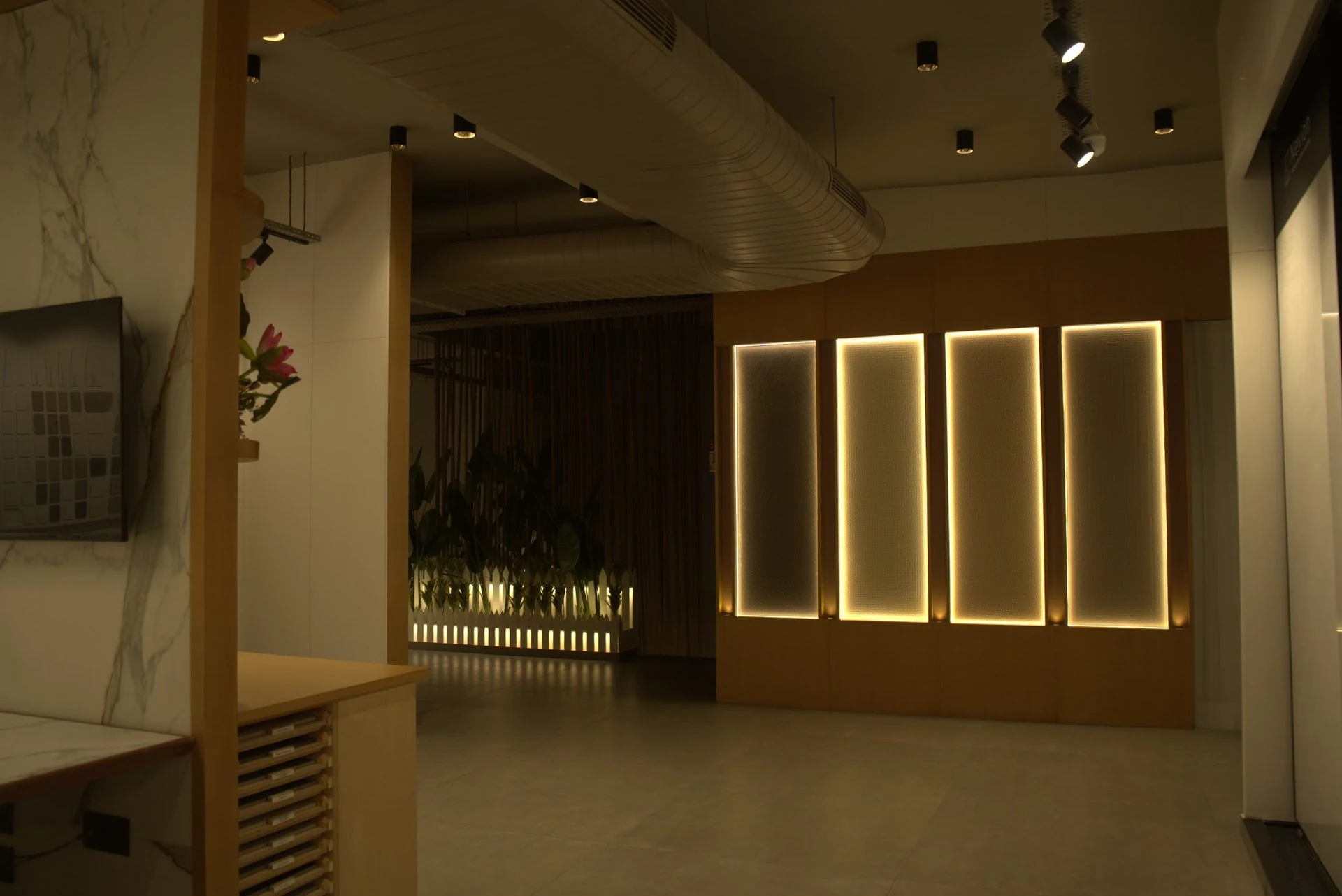
Every second customer who walks into our Noida showroom now asks for "big tiles". Most have seen a slab floor in a hotel lobby or on Instagram and want that uninterrupted look at home. About half of them leave with a different size than they came in for, and that is usually the right outcome. This guide is what we tell people across the counter: what large format actually means in India, where it works beautifully, where it causes trouble, what it really costs in Delhi NCR once labour is added, and how to make sure it is laid properly.
What counts as a large format tile in India
There is no official cut off, but the trade in India treats anything with one side of 600 mm or longer as large format. Under that umbrella sit very different products. A 600x1200 mm glazed vitrified tile from Morbi is a large format tile. So is a 1200x2400 mm, 6 mm thick porcelain slab from an Italian influenced brand such as Nexion. They are priced, handled and installed in completely different ways, which is why the phrase alone tells a tile shop very little.
Two technical terms matter more than the marketing. The first is water absorption. Porcelain, as defined under the Indian standard IS 13006 (aligned with the international ISO 13006 classification), absorbs less than 0.5 percent water, which is what gives it the density to be produced as a thin, wide slab without warping. The second is rectified edges. A rectified tile is machine cut after firing so that every piece is exactly the same size with a square edge, allowing joints of 2 mm or less. Nearly all genuine large format porcelain is rectified. If a supplier cannot confirm both figures, the product is probably a standard vitrified tile in a bigger box.
Common sizes, and what each one is for
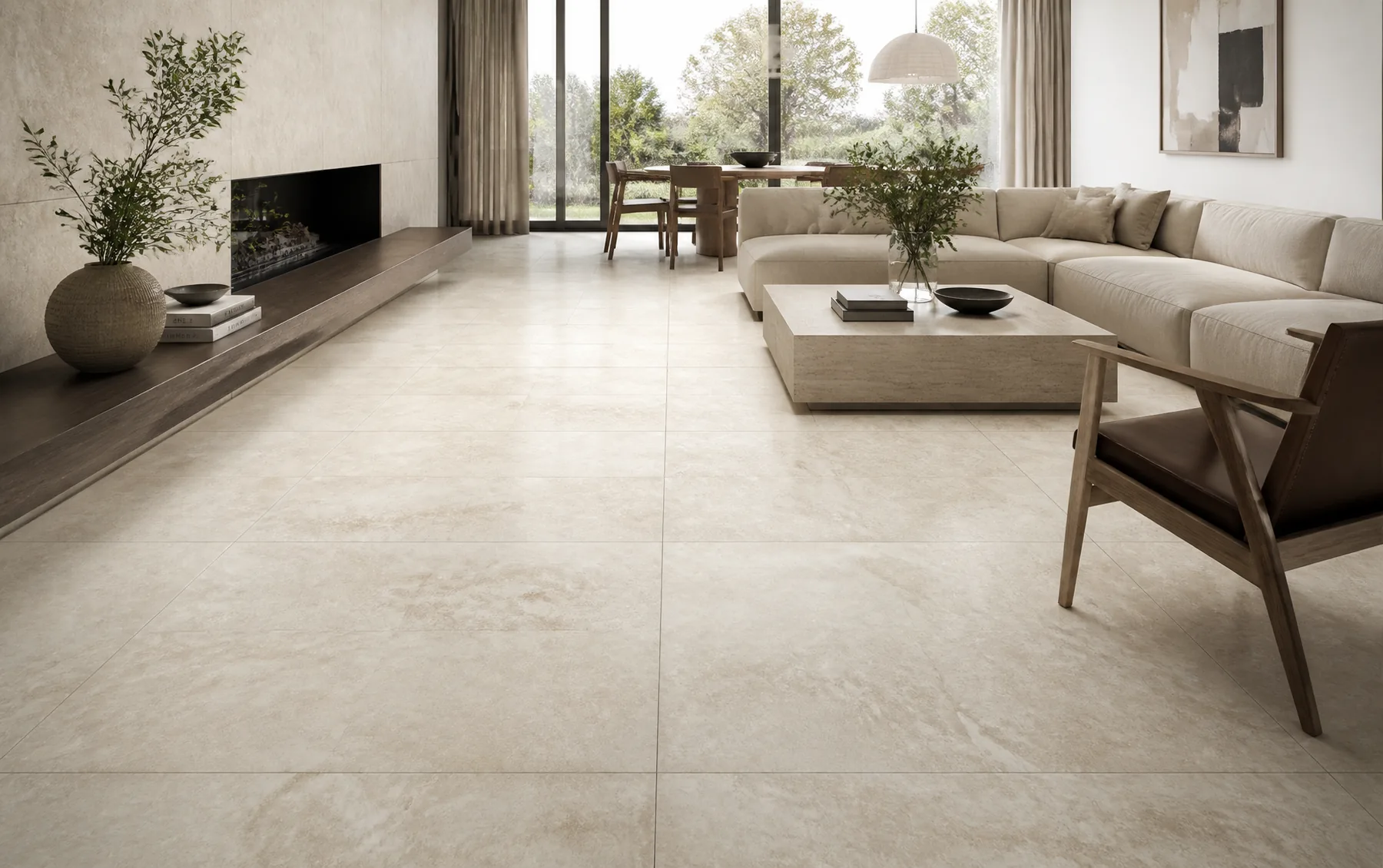
The Indian market has settled on a handful of formats. The table below is how we explain them to a family renovating a three bedroom flat in Noida, which is the most common brief we see.
| Size (mm) | In feet | Typical thickness | Best used for | Watch out for |
|---|---|---|---|---|
| 600x1200 | 2x4 | 9 to 10 mm | Bedrooms, corridors, most bathrooms, budget living rooms | Still shows a grid; choose rectified for narrow joints |
| 800x1600 | 2.6x5.25 | 9 to 10 mm | Living and dining rooms of 150 to 300 sq ft, kitchen walls | Needs two people to lay; check lift access for cartons |
| 1200x1200 | 4x4 | 9 to 12 mm | Square rooms, offices, showrooms | Square grid looks best with perfectly aligned walls |
| 1200x1800 | 4x6 | 9 mm | Feature walls, wide corridors | Wastage rises sharply in rooms under 200 sq ft |
| 1200x2400 | 4x8 | 6 mm (walls), 9 to 12 mm (floors) | Open plan living, lobbies, facades, kitchen counters, book matched walls | Needs suction lifters, a level screed and an experienced crew |
The 1600x3200 mm size exists and we can show it, but in a residential context it is a wall or countertop product rather than a floor tile. For most homes in Delhi NCR the decision is between 800x1600 and 1200x2400, and the deciding factor is nearly always room size and how many cuts the layout will need.
The case for large format
The obvious advantage is visual. Fewer grout lines mean fewer interruptions, so a 250 sq ft room laid in 1200x2400 has perhaps a dozen joints instead of two hundred. That continuity is what makes a marble finish slab look like marble rather than like a printed picture of marble. It also makes rooms feel larger, which is why we push customers with modest living rooms toward our large format collection rather than away from it, as long as the layout is drawn first.
The second advantage is hygiene and upkeep. Grout is the part of a tiled floor that stains, darkens and harbours moisture. Reducing its length by 80 percent or more changes how a kitchen or bathroom ages. Combined with the near zero absorption of porcelain, a large format floor is close to the easiest surface to keep clean that a home can have.
The third is design range. Because slabs are printed at high resolution across a large canvas, patterns such as Calacatta and Statuario veining, travertine banding, oxidised metal and cast concrete can run across a whole wall without repeating. Book matching, where two slabs are mirrored at the joint to form a symmetrical figure, is only possible at this scale. Our marble finish surfaces and stone look surfaces are all shown as full slabs in the showroom for exactly this reason: a 150 mm sample cannot tell you how a vein behaves over 2.4 metres.
The honest drawbacks
Large format is not the right answer for every room, and a good showroom will say so. The first issue is cost, and not only the tile. Adhesive consumption is higher because the tile must be back buttered as well as trowelled. Labour is charged at a premium, in Noida typically Rs 35 to 60 per sq ft for slabs against Rs 20 to 30 for standard tiles, because the work is slower and needs a crew that has done it before. Wastage is the hidden cost: a 1200x2400 slab that must be cut around a bathroom door, a kitchen island and two column projections can lose 20 percent of its area, and that offcut is worth several thousand rupees.
The second issue is substrate. A large tile will not bend to follow a wavy floor. If the screed varies by more than 3 mm over 2 metres, the tile will either rock on a high spot or bridge a hollow, and the hollow is where it will crack when a heavy sofa leg lands on it. Older Delhi homes and many builder floors need a self levelling compound before slabs can go down, and that cost belongs in the estimate.
The third is repair. A single damaged 600x600 tile is a small job. A damaged 1200x2400 slab in the middle of a living room floor means lifting a large piece, matching a batch that may no longer be in production, and hoping the replacement sits flush. We advise customers to buy 5 to 10 percent extra and store it flat. And fourth, weight and access: a carton of 800x1600 porcelain weighs close to 50 kg, and slabs are moved with suction frames. Top floor flats without a service lift add real handling cost and risk.
What large format tiles cost in Delhi NCR in 2026
Prices move with exchange rates and with the Morbi factories, so treat these as ranges rather than quotes. They reflect what customers are paying in Noida this season, exclusive of GST at 18 percent, which applies to tiles and adhesives alike.
| Product | Material only (Rs per sq ft) | Adhesive, grout and labour (Rs per sq ft) | Realistic installed range |
|---|---|---|---|
| 600x1200 GVT or PGVT, Indian | 55 to 110 | 35 to 55 | 90 to 165 |
| 800x1600 porcelain, Indian premium | 110 to 220 | 45 to 70 | 155 to 290 |
| 1200x2400 porcelain slab, Indian | 180 to 320 | 60 to 90 | 240 to 410 |
| 1200x2400 slab, Nexion and imported ranges | 250 to 600 and above | 60 to 90 | 310 to 690 and above |
Two comparisons help put that in context. Genuine Italian marble in Delhi runs Rs 350 to 1,200 per sq ft before polishing, sealing and the periodic re-polishing it needs, so a premium slab is often the cheaper route to the same look over ten years. And a full body or double charge vitrified tile in 600x600 at Rs 40 to 70 per sq ft remains the sensible floor for a rental or a budget bedroom. There is no virtue in over specifying a room that does not need it.
Which rooms suit slabs, and which do not
Living and dining
This is where large format belongs. Open plan living areas with long sightlines are the reason the format exists. Run the long side of the tile parallel to the main light source so joints fall into shadow, and continue the same tile onto the balcony threshold if the levels allow.
Bathrooms
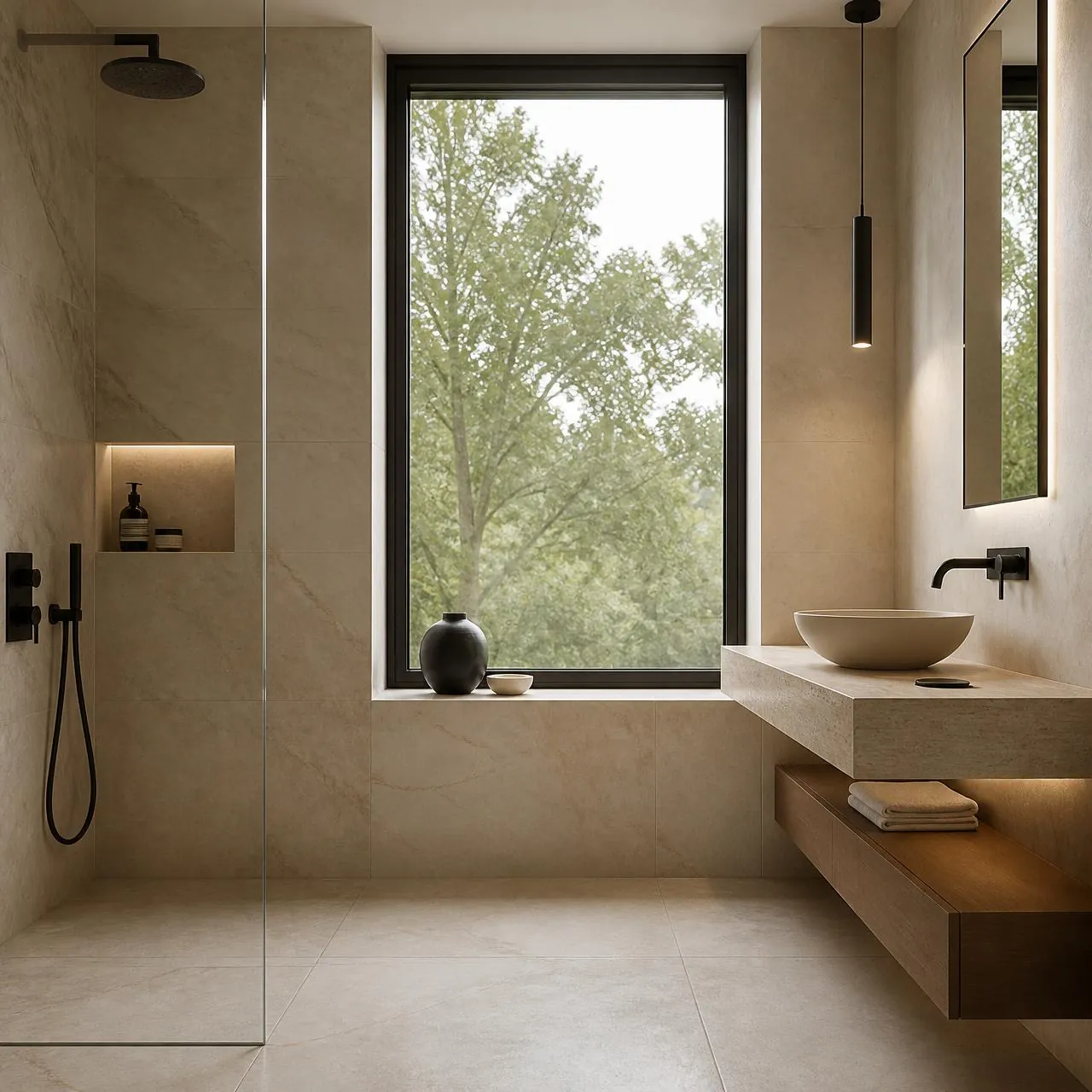
Slabs make superb bathroom walls: three pieces can clad a shower with no joints at eye level. Floors need more thought. A polished finish is slippery when wet, so the floor should be a matt or structured surface with a slip rating of R10 in a dry area and R11 in the shower zone. Floor drains also need falls, and a big tile cannot fall in two directions without being cut into a diagonal envelope, which is where an experienced installer earns their fee. Many of our customers pair a slab wall with 600x1200 matt on the floor and a Kohler or Jaquar fitting in brushed metal, which is a combination that photographs well and works for years.
Kitchens
Countertops in 12 mm porcelain slab are now a real alternative to quartz in Delhi NCR. They do not stain from turmeric or scorch from a hot kadhai, and the same slab can turn up the wall as a backsplash without a joint. Our kitchen surfaces page shows how a single material can carry floor, worktop and wall.
Bedrooms and corridors
Here the argument weakens. Rooms are smaller, furniture covers most of the floor and the budget is better spent elsewhere. 600x1200 in a wood finish or a soft concrete look gives a calm result at half the installed cost.
Facades and outdoors
Thin 6 mm slabs on ventilated facade systems and 20 mm thick porcelain for terraces are specialist products that behave well in Delhi's heat and monsoon because porcelain does not absorb water or fade. They need engineered fixing and are covered on our outdoor and facade pages rather than here.
How large format tiles are installed properly
Most complaints about big tiles are really complaints about installation, so it is worth knowing what a correct job looks like even if you never lift a trowel. The floor is checked with a 2 metre straight edge and levelled where it fails. Cement and sand mortar is not used. A polymer modified adhesive of at least C2 grade under the IS 15477 tile adhesive standard, and preferably an S1 deformable grade for slabs, is spread on the floor with a 10 or 12 mm notched trowel in straight lines, and a thin layer is also combed onto the back of the tile. That back buttering is what achieves 95 percent contact and is the single step that untrained crews skip. We stock MYK Laticrete and Kerakoll systems because both publish coverage and open time data for slab work, which lets an installer plan the job instead of guessing.
The tile is set with levelling clips at every joint so that neighbouring edges are pulled flush while the adhesive cures, which removes lippage. Joints are kept at 2 to 3 mm even on rectified tiles, since a zero joint leaves no room for thermal movement in a Delhi summer. Expansion joints are placed at doorways and at every 5 to 6 metres of continuous floor. Grouting waits 24 hours, and epoxy grout is worth the extra cost in kitchens and bathrooms because it does not stain. Foot traffic is kept off the floor for 48 hours and furniture for 72. A crew that describes the job this way without prompting is the crew to hire.
How to choose: a short decision path
Start with the room, not the tile. Measure the longest run and count the obstructions. If the room is open, above 250 sq ft and has few cuts, 1200x2400 will reward you. If it is a typical two or three bedroom flat, 800x1600 in the living area and 600x1200 elsewhere gives 90 percent of the effect at a much lower installed cost. Then pick the finish for the use: polished for walls and formal living rooms, matt or structured for anything that gets wet. Confirm porcelain body, rectified edges and slip rating on the technical sheet, not on the catalogue photo. Finally, see the actual slab in daylight. Colour, vein density and gloss change with scale and light in ways that a phone screen cannot show, which is why every large format surface we sell is displayed full size under natural light at our Sector 9 showroom in Noida.
Frequently asked questions
What counts as a large format tile in India?
Any tile with one side of 600 mm or more is sold as large format here. The common sizes are 600x1200, 800x1600, 1200x1200, 1200x1800 and 1200x2400 mm, and the biggest sizes are usually called slabs.
Are large format tiles good for small rooms and flats?
Yes, if the layout is planned first. Fewer grout lines make a small room read as one surface and feel bigger. The risk is wastage from cuts, so 600x1200 or 800x1600 is usually a better fit than 1200x2400 in a compact flat.
What are the disadvantages of large format tiles?
Higher material and labour cost, more wastage in small or irregular rooms, a strict need for a flat floor, a requirement for polymer modified adhesive rather than cement, and the expense of replacing a single damaged slab.
Which size is best for a living room, 600x1200, 800x1600 or 1200x2400?
For living rooms between 150 and 300 sq ft, 800x1600 balances a seamless look with manageable wastage. 1200x2400 suits open plan rooms above 300 sq ft and feature walls. 600x1200 remains the practical choice for bedrooms and corridors.
What is the price of large format porcelain tiles per sq ft in Delhi NCR?
Indian 600x1200 glazed vitrified starts around Rs 55 to 110 per sq ft. 800x1600 porcelain runs Rs 110 to 220. Premium and imported 1200x2400 slabs range from roughly Rs 250 to 600 and above. Add Rs 40 to 90 per sq ft for adhesive, grout and skilled labour.
Can large format tiles be laid with cement, or do they need adhesive?
They need a polymer modified tile adhesive, typically C2 grade, applied to both the floor and the back of the tile. Cement mortar cannot hold full contact under a slab and leads to hollow spots and cracks.
Do large tiles crack or show lippage more easily?
Cracking is almost always an installation fault caused by an uneven screed, hollow bedding or missing expansion joints. Lippage is more visible on big tiles, which is why levelling clips and rectified edges matter.
Are large format tiles slippery in bathrooms?
A polished slab is slippery when wet. Use a matt or structured finish with an R10 or R11 rating on bathroom floors and keep polished slabs for the walls.
See the slabs before you decide. World of Tile holds Nexion, marble finish, stone, concrete and wood finish surfaces in full 1200x2400 slabs at A/17, Sector 9, Noida, open every day from 10:30 AM to 8:00 PM. Bring your floor plan and we will work out sizes, wastage and an installed estimate on the spot.
Plan a showroom visit Message on WhatsApp