
Best Bathroom Tiles in India: Anti Skid Ratings, Sizes and Finishes That Last
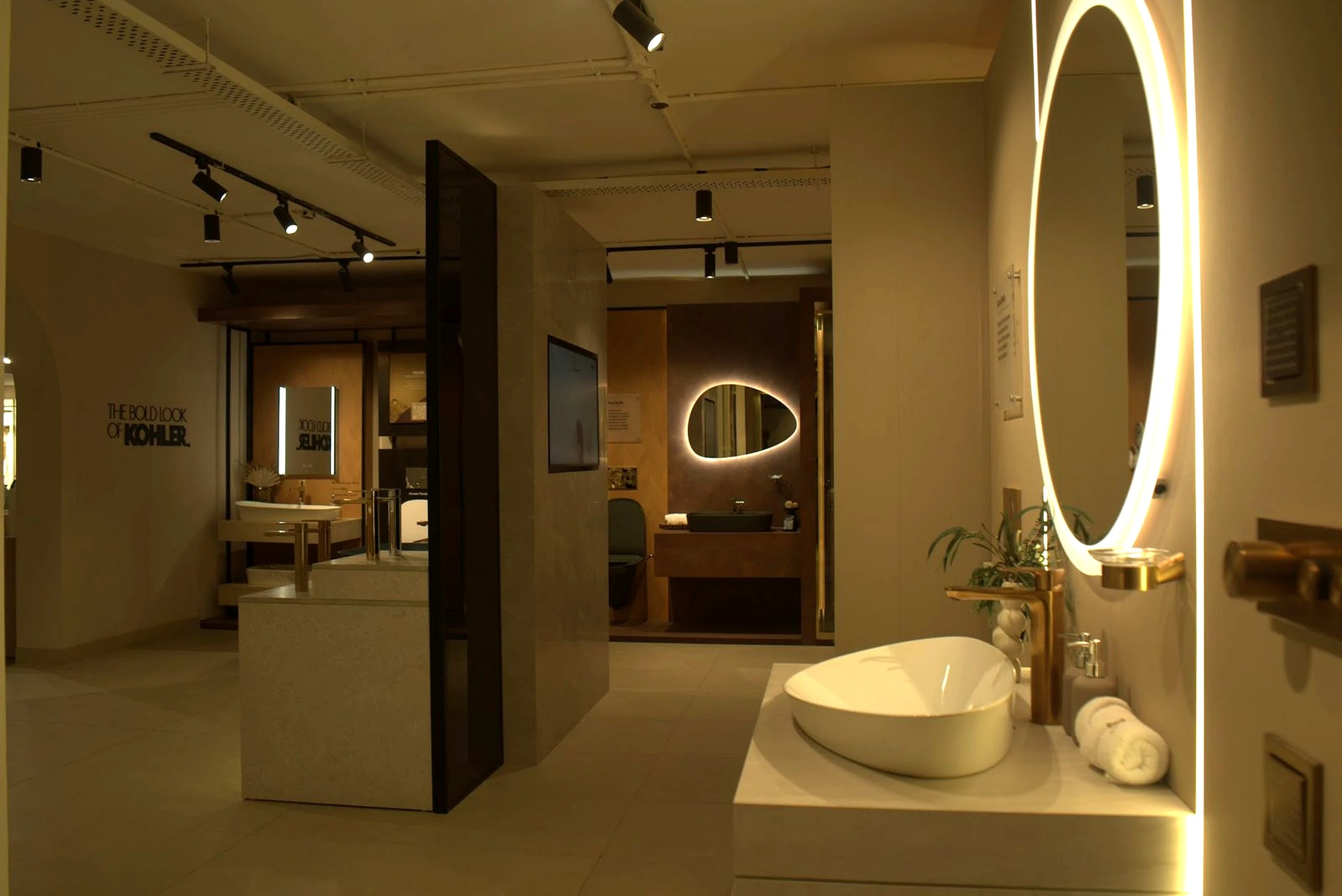
We keep a bucket of water under the bathroom display in our Noida showroom. When a customer picks a floor tile, we pour a mug over the sample and ask them to stand on it in their socks. That thirty second test has changed more decisions than any catalogue. Most people arrive thinking about colour and price, and both matter, but a bathroom tile is judged for fifteen years by whether it grips a wet foot, whether the grout stays clean and whether water actually reaches the drain. This is what we tell people across the counter about all three.
Floor tiles and wall tiles are not the same product
A bathroom needs two different tiles with two different specifications. A wall tile carries only its own weight and a film of water, so it can be a ceramic body with a glazed face, polished to a mirror, and as thin as 7 or 8 mm. A floor tile takes a wet foot, a dropped shampoo bottle, a bucket dragged across it and standing water around the drain every day. It must be dense, hard to scratch and, above everything else, not slippery when wet.
Indian showrooms often sell a "bathroom concept" where one series comes as a 300x600 wall tile and a 300x300 or 600x600 floor tile. That is a fine starting point, but check that the floor piece is genuinely floor grade. The carton or technical sheet should state a water absorption figure, an abrasion class and a slip rating. If the floor tile has none of these, or has a glossy face, it is a wall tile in a square box. We see it every week.
Slip ratings explained: R9 to R13, barefoot classes and DCOF
Anti skid is the phrase every customer uses and almost nobody can define. There is no single anti skid tile. There are tested ratings, and three systems turn up on Indian cartons and data sheets.
The ramp test and the R scale
The R rating comes from a German test, DIN 51130, in which a person wearing standard boots coated in oil walks on the tile while a ramp is tilted. The angle at which they slip gives the grade. R9 means slipping began between 6 and 10 degrees, R10 between 10 and 19, R11 between 19 and 27, R12 between 27 and 35, and R13 above 35 degrees. Most polished vitrified tiles do not reach R9. Most matt porcelain sits at R10. Structured, sugar and outdoor finishes reach R11 and above.
That test was designed for shod feet in factories, so a second test, DIN 51097, repeats it barefoot on a soaped surface and gives a letter: A for slipping at 12 degrees, B at 18 and C at 24. For a domestic shower floor we ask for class B. Class C is a pool deck and feels rough indoors.
DCOF and the 0.42 threshold
The American system measures the dynamic coefficient of friction, or DCOF, with an instrument dragged across a wet tile under the ANSI A326.3 method. A value of 0.42 or higher is the accepted minimum for an interior floor that will be walked on wet. Imported tiles and the Nexion ranges usually quote a DCOF alongside the R grade. Indian made tiles under the Bureau of Indian Standards code, IS 13006, are classified by absorption and strength rather than slip, so an Indian carton with an R value is quoting the German test voluntarily. Treat a missing figure as a polite no.
What R10 and R11 mean for a wet zone
A bathroom in a Noida flat has two zones. The dry zone around the basin and toilet gets splashed, dries in an hour and is walked on in slippers. R10 is right for it. The wet zone is the shower floor and the half metre around it, where water pools, soap sits on the surface and the foot is bare. That is R11 or class B territory. The difference is visible: R11 tiles have a fine grain or a raised structure you can feel with a fingernail, and they hold more dirt.
The trade off is real. R12 and R13 surfaces are safe on a hospital ramp and unpleasant in a home, because they scrape the mop and the skin. For elderly parents, a child's bathroom or anyone recovering from a hip or knee operation, we go to R11 across the whole floor. For a guest bathroom used a few times a week, R10 matt throughout with a mat in the shower is a reasonable economy.
Water absorption, and why porcelain wins in wet areas
Slip is the first test and absorption is the second. Under IS 13006, which follows the international ISO 13006 classification, tiles are grouped by how much water they take in by weight. Porcelain and full body vitrified sit in group BIa at under 0.5 percent. Ordinary glazed ceramic wall tiles sit in group BIII at above 10 percent. That twenty fold difference is the whole argument for porcelain on a bathroom floor.
A body that soaks up water swells slightly and pushes the glaze into crazing, the hairline cracks seen on old Delhi bathroom walls. It holds moisture under the tile, which is why old floors sound hollow and lift near the drain. And it stains from the back, so a pale tile grows a grey shadow around the shower. Porcelain does none of this, which is why we put porcelain on every floor and around every drain, and ceramic only on walls where budget matters. Our vitrified versus porcelain versus ceramic comparison goes through the three bodies in detail. One consequence follows: porcelain cannot bond to a cement and sand bed, so it must go down on a polymer modified adhesive.
Finishes: matt, structured, sugar, lapato and polished
The matt versus glossy argument usually runs between one partner who wants the shine of a hotel bathroom and another who has slipped in one. Both belong in a bathroom, in different places, and there are more than two finishes to choose from.
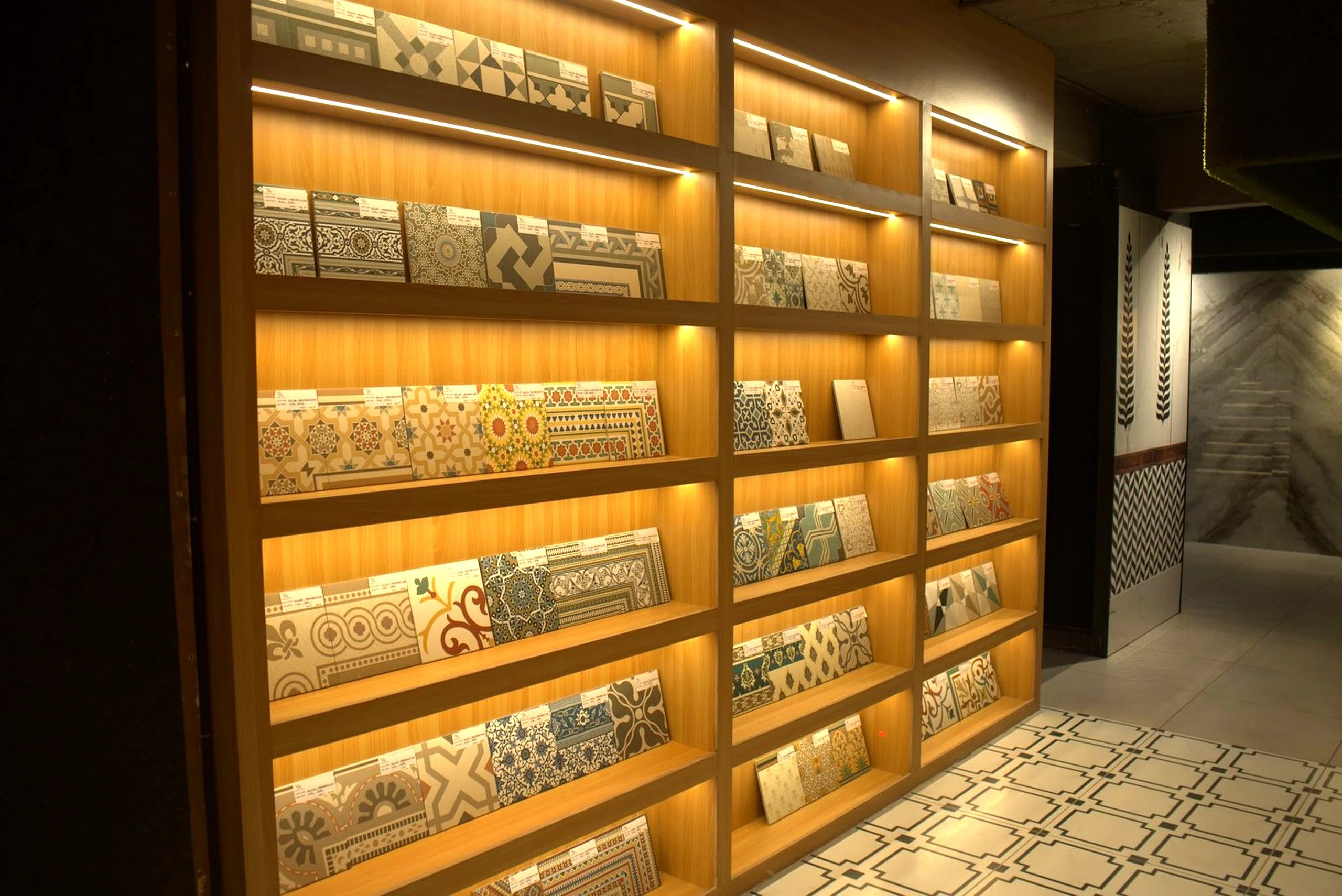
Matt is the everyday floor finish, usually R10, calm under light and forgiving of water marks. Structured means the surface carries a moulded texture, often following the stone or wood it imitates, and reaches R11 comfortably. Sugar finish, sometimes labelled granilla or carving on Morbi cartons, has a fine crystalline grain that catches light, gives R11 grip and looks richer than plain matt. Lapato, also called semi polished, is a matt tile lightly honed so the high points shine. It sits at R9 to R10 and is a wall finish or a dry zone floor at most. Polished and glossy are for walls only, full stop.
The pairing we recommend most for a Noida flat is a polished marble finish on the walls with the same design in matt or sugar on the floor. Many series from Nexion and from good Morbi factories are made in both surfaces for this reason, and the colour match is far closer than mixing two series.
Sizes for small Indian bathrooms, and the falls that go with them
Which sizes fit a 5 by 7 bathroom
The common Delhi NCR bathroom measures between 5 by 7 ft and 6 by 9 ft, with a door, a window, a WC outlet and a floor trap in the corner. The sizes that work are 300x600 on the walls and 600x600 or 600x1200 on the floor. 300x600 needs few cuts on a 7 ft wall and its horizontal joints make a low ceiling read wider. 600x600 is the easiest floor tile to lay to a fall. 600x1200 looks cleaner but needs planning so the cut pieces land at the back of the room, not at the door.
Large format on the walls is the upgrade worth considering. Two 1200x2400 slabs can clad a shower wall with no joint at eye level, and a slab behind the basin makes a small bathroom feel like a bigger one. We covered handling and cost in our large format tiles guide; the short version for bathrooms is that slabs belong on walls, while the floor stays at 600x1200 or smaller so it can be cut to a fall without wasting most of a slab. The large format range is displayed at full height in the showroom.
Falls, drains and the envelope cut
A bathroom floor must slope toward the drain at roughly 1 in 80 to 1 in 100, about 10 to 12 mm over a metre. A 300x300 tile follows that slope without thought. A 600x600 or 600x1200 tile is a flat plane, so the installer cuts the tiles around the trap into a diagonal envelope, four triangles meeting at the drain, each sloping toward it. A linear drain along the shower wall solves this because the whole floor falls one way and the tiles stay whole. Kohler and Jaquar both make linear drains that suit 600x1200 floors, and we specify them on most shower floors now. The screed does the falling, not the adhesive, so ask the contractor to form the fall in the screed and test it with a bucket of water before tiling.
Grout: epoxy versus cement in a Delhi bathroom
Tile is the part of a bathroom that lasts. Grout is the part that ages, and in Delhi it ages fast. Cement grout is porous: it takes in water every time the shower runs, holds it through the monsoon, and within two years the white lines turn grey and then black with mould. Bleach whitens it for a month. Epoxy grout is a two part resin that cures to a non porous, stain proof joint that stays the colour it was on day one.
The costs, as ranges that move with the season: cement grout is a few rupees per sq ft, epoxy roughly Rs 15 to 35 per sq ft including the extra labour, because epoxy sets fast and must be cleaned off the tile face within minutes. On a 50 sq ft floor plus the shower walls the difference is usually under Rs 5,000, which is the best money in the whole job. We stock MYK Laticrete and Kerakoll epoxy grouts and go through the adhesive and grout choice in our adhesive versus cement article. Keep joints at 2 to 3 mm on rectified tiles: wide joints mean more grout, more cleaning and more chance of a stain.
Colour, light and the fittings on the wall
Windowless bathrooms and borrowed light
Many bathrooms in Noida towers and builder floors have no window, only an exhaust and one ceiling light. Colour does more work here than anywhere else in the home. Warm whites, beiges and ivories bounce light without the glare of pure white and hide water spots better than dark or bright surfaces. A glossy wall reflects the ceiling light down onto the floor, which is why glossy walls are a practical choice in a windowless room, not just a style one. A dark floor with light walls reads well; dark walls under a single downlight make the room feel like a cupboard.
Lamp colour matters as much as tile colour. A 3000 K warm white flatters beige and ivory, while 4000 K neutral white suits grey and concrete look surfaces. Customers often see a grey tile under our showroom daylight and are surprised by how brown it looks under a warm bulb at home, so we lend samples overnight. The bathroom surfaces page shows the combinations we photograph most.
Pairing tiles with Kohler and Jaquar
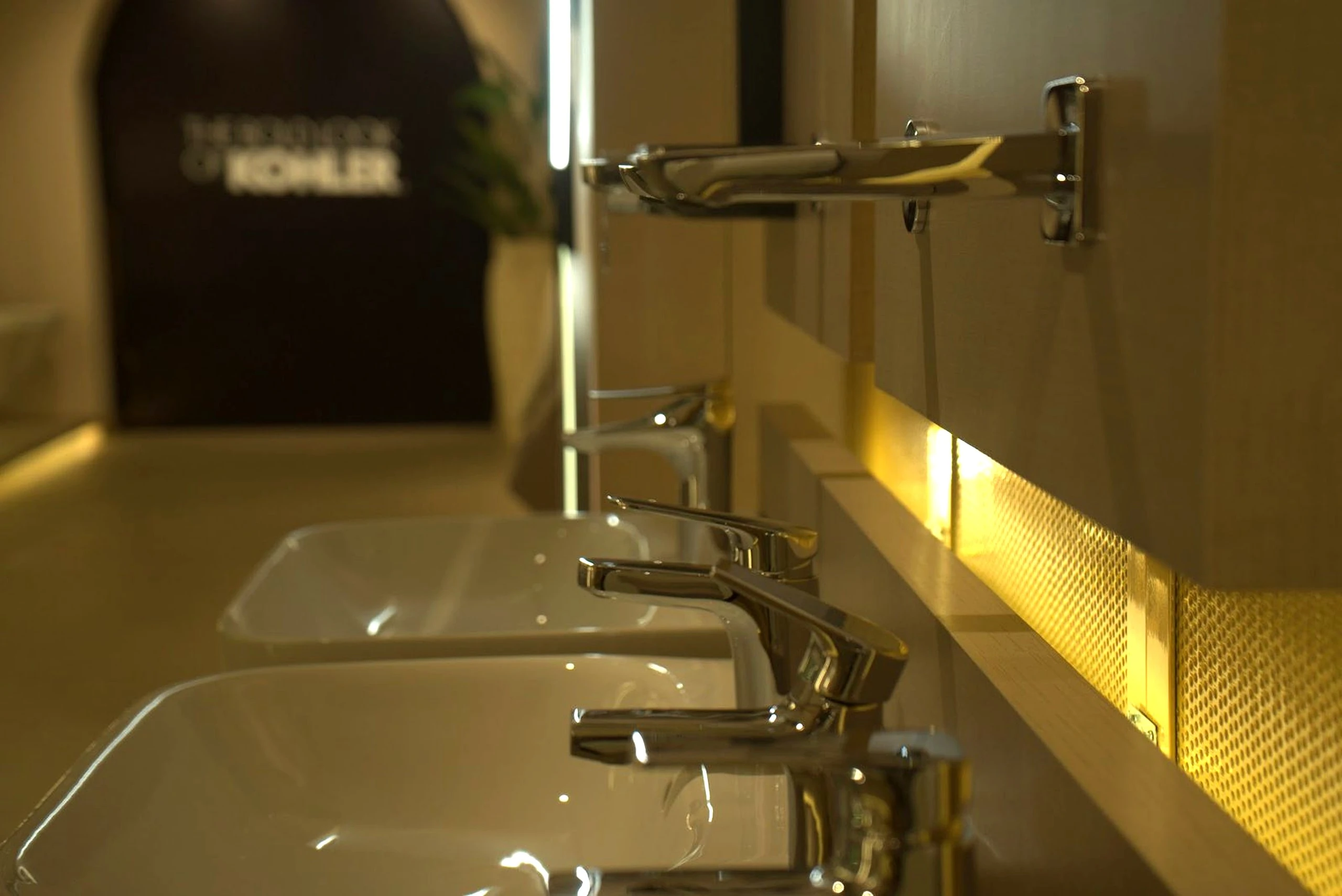
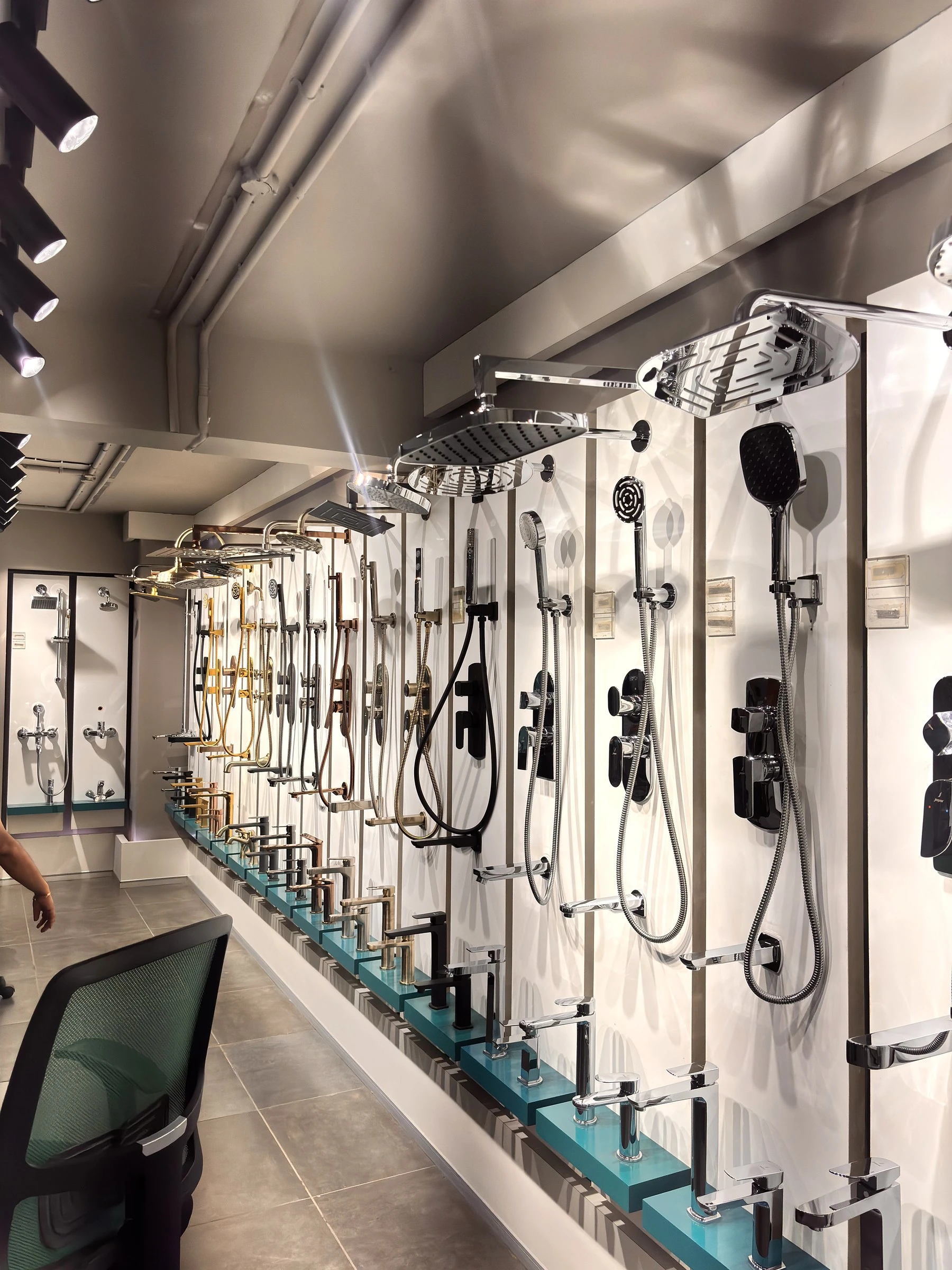
The bathroom is finished by the metal on the wall, and the tile should be chosen with the fittings in mind. Kohler and Jaquar both offer chrome, brushed nickel or stainless, matt black and a brushed or rose gold. Chrome is the safe partner for white, grey and marble finish walls. Brushed finishes sit well on stone and sand tones and do not show water spots. Matt black is striking against pale ivory or a light concrete look and disappears against dark grey. Gold tones need a warm tile, a cream marble finish or a terracotta tone, and look cheap against cold grey.
Two practical points come before the aesthetic ones. A wall hung toilet with a concealed cistern needs the wall built out by about 200 mm, which changes the tile layout and must be planned before the first cut. A rain shower on a ceiling arm needs the wall tile to stop where the false ceiling begins. Bring the fittings list with the floor plan and we lay out tiles and fittings together; if the choice of brand is still open, our Kohler versus Jaquar comparison covers it.
Tile types by bathroom zone, and how to keep them looking new
The table below is how we specify a bathroom when a family brings in a plan. Prices are Delhi NCR material ranges this season, before GST at 18 percent, and they move with Morbi and with exchange rates.
| Zone | Tile body | Finish and slip grade | Size (mm) | Material (Rs per sq ft, moves) | Grout |
|---|---|---|---|---|---|
| Shower floor | Porcelain or full body, under 0.5 percent absorption | Structured or sugar, R11 or barefoot class B | 600x600, or 600x1200 with a linear drain | 70 to 220 | Epoxy, 2 to 3 mm joint |
| Dry floor (basin, WC) | Porcelain or PGVT matt | Matt, R10 | 600x600 or 600x1200 | 60 to 200 | Epoxy preferred |
| Shower walls | Porcelain, PGVT or ceramic | Polished, glossy or matt; no slip grade needed | 300x600, 600x1200 or slab | 45 to 400 and above for slabs | Epoxy |
| Other walls | Ceramic or PGVT | Glossy for light, matt for calm | 300x600 or 600x1200 | 35 to 150 | Cement acceptable, epoxy better |
| Basin counter and niche | Porcelain slab, 12 mm | Polished or matt | Cut from 1200x2400 | 250 to 600 and above | Epoxy, silicone at edges |
| Ledge, step, kerb | Full body porcelain | Matt, R10 or R11 on the tread | Cut with a mitred edge | 90 to 250 | Epoxy |
Maintenance for anti skid floors
The one complaint about R11 tiles is that the texture holds soap film and looks dull after a few months. The fix is a routine, not a product. Mop with warm water and a small measure of a pH neutral cleaner made for vitrified tiles, rather than acid, phenyl or a bleach that eats the grout. Once a week go over the shower floor with a soft nylon brush, because a mop glides over the high points of a structured tile and leaves the film in the valleys. Rinse and squeegee so the hard water from a Noida bore or tanker does not dry into a white bloom.
Never use an oil based or shine cleaner in a bathroom. It fills the texture that gives the tile its grip and makes an R11 floor feel like R9. A warm water and mild alkaline wash brings the grip back. Epoxy joints need nothing beyond the same mop. Cement joints should be sealed once a year, a chore most households forget and one more reason we push epoxy.
How to choose: a short decision path
Start with the floor, because it has the strictest requirements, and settle the walls afterwards. Decide who uses the bathroom. If it is a parent, a young child or anyone unsteady, the whole floor is R11 or barefoot class B, no exceptions. For everyone else, R11 or class B in the shower and R10 matt across the dry zone. Confirm the body is porcelain or full body vitrified with absorption under 0.5 percent by reading the technical sheet, not the catalogue. Then pick the size: 600x600 or 600x1200 for the floor, with a linear drain if you want the larger tile whole.
Now the walls. Take the same series in a polished or glossy surface if the bathroom has no window, matt if it has daylight and you want a calmer room. Go to a slab on the shower wall or behind the basin if the budget allows, and keep 300x600 or 600x1200 elsewhere. Fix the tap finish next: chrome for cool colours, brushed for stone tones, black or gold only against a tile that sets it off. Specify adhesive rather than cement, epoxy grout on the floor and in the shower, and a screed fall tested with water before tiling. Finally, bring the plan, the fittings list and a photo of the bathroom to our Sector 9 showroom in Noida, where every floor tile we recommend can be tested wet, in socks, before you buy it.
Frequently asked questions
Which tiles are best for a bathroom floor in India?
A porcelain or full body vitrified tile with water absorption under 0.5 percent, a matt or structured surface, and a slip rating of R10 in the dry area and R11 in the shower zone. In most Delhi NCR flats that means 600x600 or 600x1200 matt porcelain laid on adhesive with epoxy grout.
What does R11 mean on a bathroom tile?
R11 is a grade from the German ramp test, DIN 51130, in which a tester in oiled boots walks on a tilting ramp. R11 means slipping began between 19 and 27 degrees. It is the grade we recommend for shower floors. R10, which slips between 10 and 19 degrees, is enough for the dry side of a bathroom.
Is R10 enough for a bathroom floor?
R10 is adequate for the dry zone around the basin and toilet, which gets splashed but not soaked. For the shower floor, or for any bathroom used by elderly parents or small children, step up to R11 or a tile with a barefoot rating of class B. The price difference is usually small.
Are matt or glossy tiles better for a bathroom?
Matt for the floor, either for the walls. A glossy or polished tile becomes slippery the moment it is wet, so it belongs on walls only. Matt, sugar and structured finishes hold grip and hide soap film. Glossy walls bounce light, which helps in a windowless bathroom, but they show every drip until wiped.
What size tile is best for a small bathroom?
For a typical 5 by 7 ft or 6 by 8 ft Indian bathroom, 300x600 on the walls and 600x600 or 600x1200 on the floor wastes least and keeps the drain falls simple. Larger tiles reduce grout lines and make the room feel bigger, but the floor must be cut into an envelope around the drain so water runs off.
Do bathroom tiles need to be porcelain, or is ceramic fine?
Ceramic wall tiles absorb 10 percent or more of their weight in water, which is acceptable on a wall where nothing stands on them. On the floor, in the shower and around the drain, use porcelain or vitrified with absorption below 0.5 percent so the body does not soak, stain or lift in the monsoon.
Is epoxy grout worth the extra cost in a bathroom?
Yes, on the floor and in the shower. Cement grout absorbs water, darkens and grows mould within a year or two in a Delhi bathroom. Epoxy grout is non porous, keeps its colour and wipes clean. It costs more and needs a careful installer, but on a 40 to 60 sq ft bathroom the difference is a small share of the job.
How do I stop anti skid bathroom tiles from looking dirty?
Structured and sugar finish tiles trap soap film in their texture, so mop with warm water and a mild pH neutral cleaner rather than acid or phenyl, go over the shower floor with a soft brush once a week, and keep the joints in epoxy. Avoid oil based cleaners, which leave a film that makes even an R11 tile feel slippery.
Test the floor wet before you buy it. World of Tile keeps R10 and R11 porcelain floors, marble finish and stone look walls, Nexion slabs and the Kohler and Jaquar fitting ranges under one roof at A/17, Sector 9, Noida, open every day from 10:30 AM to 8:00 PM. Bring your bathroom plan and we will work out zones, sizes, falls and an installed estimate while you wait.
Plan a showroom visit Message on WhatsApp